
Onondaga County Active Warrant Search Portal
The Onondaga County Sheriff's Office maintains an active-warrant search at sheriff.ongov.net/awarrants/. This is a direct, public tool. No account, no payment, and no third-party subscription is needed. A user types in a last name, adds a first name to narrow results, and hits search. Results reflect warrants currently held by the Onondaga County Sheriff. The list updates as warrants are added, served, or recalled, though the exact refresh cycle is not stated on the portal.
The portal matters because most New York counties do not publish a live warrant list. Many counties require a call to the court or the sheriff to check warrant status. Onondaga does it differently. The public active-warrant search is a real tool that users in other New York counties often cannot find. If you need to check whether a name carries an active warrant held by the Onondaga County Sheriff, the portal is the right first stop.
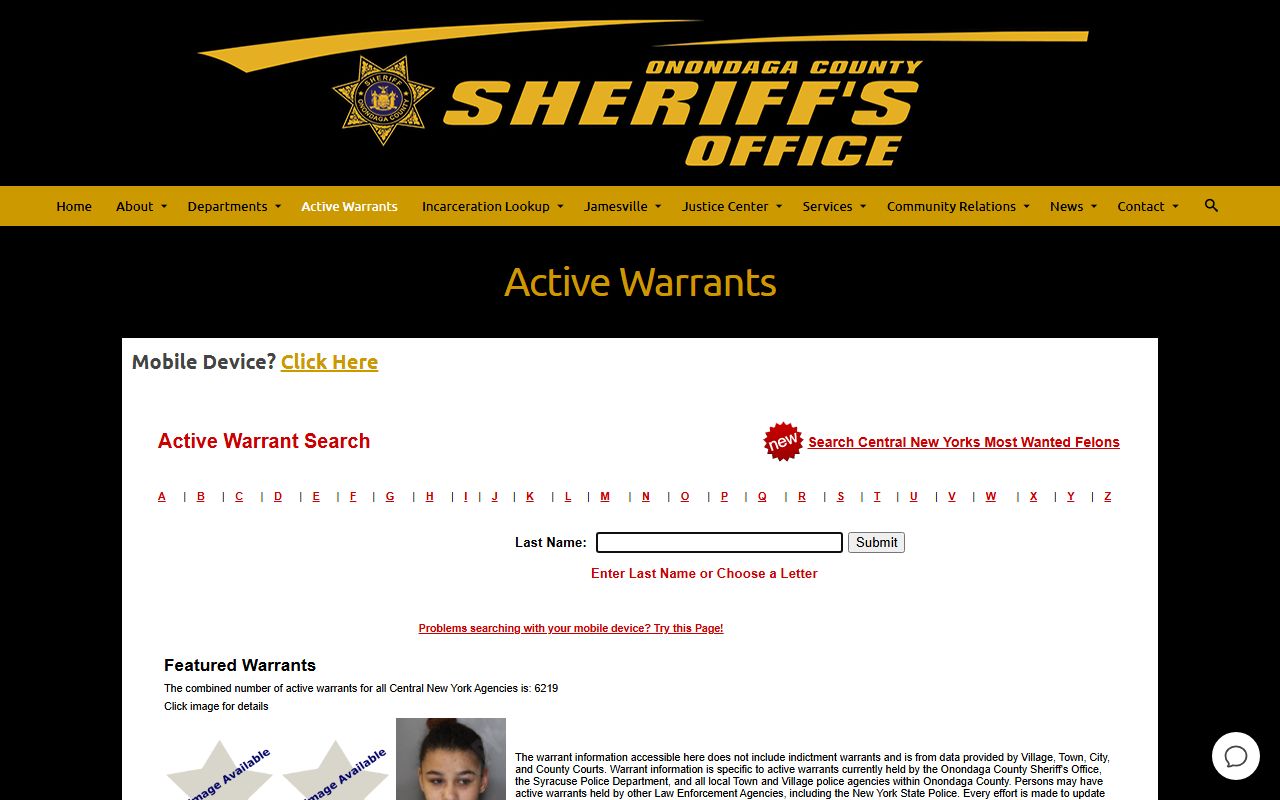
The Onondaga active-warrant search covers warrants held by the Sheriff's Office and reflects the official warrant list maintained by the department as of the last update cycle.
| Field Label | Type | Required | Options / Format Notes |
|---|---|---|---|
| Last Name | Text | Usually required | Enter the subject's surname for the Onondaga active-warrant search. |
| First Name | Text | Optional | Narrows results when multiple names match on the last name alone. |
| Search / Reset | Button | n/a | Run the query or clear fields and start over. |
A result from the portal shows the person's name and the warrant information on file. It does not show sealed warrants, sealed indictments, juvenile matters, or investigative warrants that are not yet public. A clean result means no active warrant appears in the Sheriff's system for that name; it does not mean the person has no warrant in any court or any jurisdiction. Town and village justice courts, Family Court, and federal courts run separate systems.
Onondaga County Warrants Mobile Search App
The Sheriff's Office also provides a mobile-friendly active-warrant application at psi2.ongov.net/AWarrants/app/index.jsp. This version is built for smaller screens and touchscreen use. The underlying data is the same active-warrant list from the Sheriff. A user who prefers to search from a phone or tablet can use this URL directly.
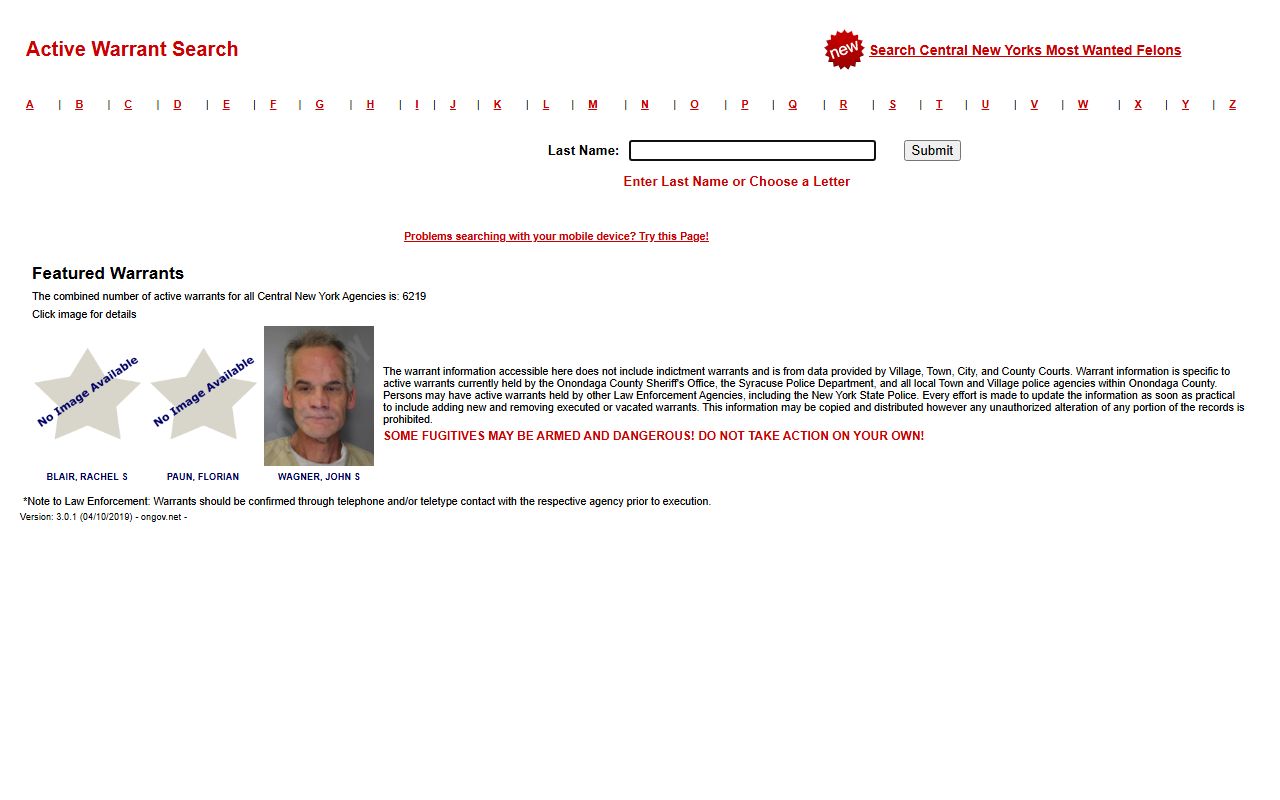
The mobile active-warrant search app provides the same Onondaga County warrant data as the main portal in a format suited to phones and tablets.
Both URLs, the desktop portal and the mobile app, pull from the same source. A search run on the app and one run on the full site should return the same results. If results differ between one day and the next, that reflects changes to the active list, not a gap between the two interfaces. The Sheriff's warrant list changes as new warrants are signed, old warrants are served, and courts recall them.
Onondaga County Warrants Investigation Unit
Behind the public portal is an active law enforcement unit. The Warrants Investigation Unit of the Onondaga County Sheriff's Office handles the location, service, and enforcement of active warrants in the county. The unit works with courts, other agencies, and out-of-county law enforcement on fugitive and multi-jurisdiction warrant cases. Its role is not just to hold a list; it actively pursues people with outstanding warrants.
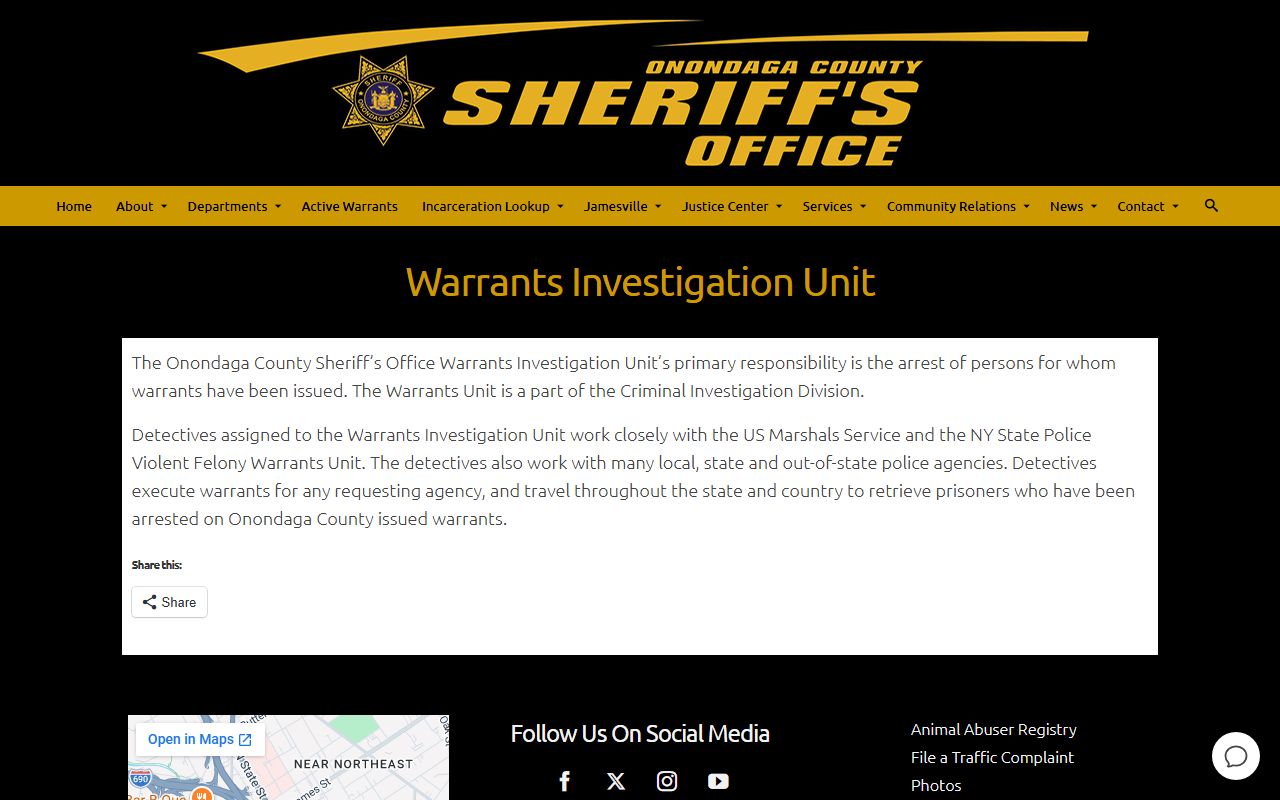
The Warrants Investigation Unit page on the Sheriff's website describes the unit's mission and provides context for how active warrants are pursued in Onondaga County.
The Warrants Investigation Unit is the right contact point for questions about whether a warrant is being actively pursued, whether an agency hold has been placed, or how to arrange a voluntary surrender with the Sheriff's Office rather than waiting for street enforcement. Voluntary surrender through counsel or directly with the unit is almost always a better outcome than an arrest during a traffic stop or a courthouse visit on an unrelated matter. The unit's contact information appears on the official page at sheriff.ongov.net/police/warrants-investigation-unit/.
Types of Warrants in Onondaga County
New York courts and the Onondaga County Sheriff issue several kinds of warrants. Each type has a different legal basis, a different purpose, and a different path to resolution. Knowing which type applies to a situation is the first step toward handling it correctly.
- Arrest warrant: A judge signs this when there is legal basis to take a person into custody on a criminal charge. It directs law enforcement to find and arrest the named individual.
- Bench warrant: A court issues this when a person fails to appear as required. Bench warrants are common in criminal and civil cases and can arise from a missed hearing, a failure to pay a fine, or a violation of release conditions.
- Search warrant: Authorizes law enforcement to search a place, a vehicle, or a person for specified items or evidence. A search warrant may be sealed before it is executed and may not appear in any public search.
- Fugitive or out-of-county warrant: Issued when another jurisdiction is seeking a person believed to be in Onondaga County. Extradition or transfer procedures apply.
- Violation warrant: Arises when a person violates probation, parole, or another court order. The violation is reported to the supervising court, which may issue a warrant for the person's return.
- Civil enforcement process: Not a criminal warrant but still a court-authorized enforcement action. A warrant of eviction in a landlord-tenant matter is one example. These are handled through the Sheriff's civil records unit rather than the criminal warrant system.
The court that signed a warrant is the only court that can recall, vacate, or modify it. A bench warrant from Onondaga County Court at 401 Montgomery Street is handled by that court, not by the Sheriff's records window. A City Court bench warrant from 505 South State Street goes back to that court. The Warrants Investigation Unit enforces warrants but does not recall them.
What the Onondaga Warrant Search Returns
A positive result in the Onondaga County active-warrant search means the Sheriff's Office has an active warrant on file for that name. The result reflects warrant details as maintained in the Sheriff's system. The portal is a real-time tool, not an archived list. When a warrant is served or recalled by the court, it should drop from the active list, though there can be a short lag between a court event and the database update.
What does not appear is just as important. The portal reflects Sheriff-held warrants. A court can issue a bench warrant the Sheriff has not yet received. A sealed indictment carries a warrant component that stays sealed until the court orders otherwise. Juvenile delinquency warrants are not public. Family Court warrants in custody or family-offense matters are governed by the Family Court Act's confidentiality framework and will not appear. Investigative warrants tied to ongoing criminal investigations often stay sealed until execution.
The portal is a useful first check. For employment, licensing, immigration, or housing purposes where warrant status must be confirmed with certainty, a certified disposition from the relevant court is the document that counts. The Onondaga County court records page explains the difference between a portal result and a certified court record.
Note: A clean result on the active-warrant portal does not rule out sealed warrants, juvenile warrants, Family Court warrants, or warrants held by courts outside Onondaga County.
Using WebCrims for Onondaga County Case Appearances
The Onondaga County active-warrant portal covers Sheriff-held warrants. A related but different tool is WebCrims, the New York Unified Court System portal for public criminal case appearances. WebCrims is useful when a person wants to confirm the status of a court case, check a next appearance date, or see whether a bench warrant appears to have been added to a case in the Onondaga County Court or Syracuse City Court.
A WebCrims search for Onondaga County returns case identifiers, the court, the next appearance date, and case status for public criminal matters. It is most reliable for County Court and Syracuse City Court matters. Town and village justice court coverage can be thinner because those courts do not all push data to the state portal the same way. Sealed cases, youthful offender matters, and juvenile files will not appear in WebCrims at all.
The cleanest use of WebCrims for warrant questions is to look up the underlying case, check the last and next appearance entry, and call the court clerk if something looks off. Counsel can often get a definitive answer from the part clerk much faster than a public portal search can. WebCrims is not a warrant clearance tool. It is a case-status and appearance tool that provides context alongside the active-warrant portal search.
How to Resolve an Outstanding Onondaga County Warrant
An active warrant does not get better with time. A bench warrant sitting quietly in the system can lead to an arrest during a routine traffic stop on I-81, a visit to a courthouse on an unrelated matter, or a standard background check that turns up the entry. The steps below follow the practical path for resolving a warrant in Onondaga County through the Fifth Judicial District courts.
- Do not ignore it. Warrants do not expire on a calendar. They are recalled by court order, and a person with an active warrant can be arrested at any time in any jurisdiction that runs the system.
- Contact a defense attorney. A lawyer can confirm the warrant details, identify the issuing court and case number, and contact the court or the Warrants Investigation Unit on your behalf. If you cannot afford counsel, contact the Onondaga County Bar Association Assigned Counsel Program or ask about public-defender eligibility.
- Identify the issuing court and case number. Paperwork from prior court appearances, the WebCrims portal, or a direct call to the relevant court will show where the warrant was issued and under which docket or indictment number it sits.
- Ask about a voluntary appearance. Courts in Onondaga County generally respond better to a person who walks in with counsel and a clear plan than to one brought in by the Warrants Investigation Unit. Ask counsel or the court whether a voluntary appearance date can be arranged, what bail or release conditions may apply, and whether a motion to vacate or recall the warrant is an option.
- Gather what you need for the appearance. Bring government-issued photo identification, any court paperwork from the original case, proof of compliance with prior conditions, payment records for prior fines or surcharges, and an emergency contact in case of remand.
- Attend the court date. Bring all materials, arrive on time, and let counsel lead contact with the court. A judge can recall a bench warrant on the record during the appearance itself.
- Confirm the warrant is cleared after court action. The active-warrant portal and the Sheriff's database may take a day or two to reflect a recall. Get court paperwork showing the warrant was recalled before leaving the courthouse, and check the portal again after a short delay to confirm the update.
Warrants, Charges, and Convictions Are Not the Same
A common mistake is treating a warrant as proof of guilt. It is not. A warrant is a court order that something must happen. It does not mean the charge has been proved, that the person is guilty, or that a conviction will follow. A person with an outstanding bench warrant may have a completely defensible case behind it; they simply need to get back in front of the judge.
Warrant vs Charge vs Conviction. A warrant authorizes an action by law enforcement. A charge alleges that a person committed an offense. A conviction is a court finding of guilt after plea or trial. Each step sits in a different part of the record, carries different rights and consequences, and is governed by different sealing rules.
That distinction matters in practical settings. A bench warrant on an unpaid traffic fine from Syracuse City Court at 505 South State Street is not the same thing as an arrest warrant on a felony charge pending in County Court at 401 Montgomery Street. Both can show as active warrants in the right system, but they carry very different legal weight. The full case file, available through court records or court dockets, shows the difference. The warrant portal alone does not.
A warrant can also appear in a background check without a conviction beside it. For employment, housing, or licensing purposes, the warrant and the underlying case are separate items that produce different results depending on how the requester asks the question and which records they pull.
Sealed and Confidential Warrants in Onondaga County
Not every warrant becomes a public record. New York law and court rules protect several categories of warrant from general public view. A search warrant issued in connection with an active criminal investigation may stay sealed until it is executed and the court orders it unsealed. Grand jury indictments in Onondaga County Court can be sealed for safety or investigative reasons. Those sealing orders can cover the warrant component of an indictment.
Family Court warrants are restricted by the Family Court Act's confidentiality framework. A warrant issued in a custody, child-protective, family-offense, or juvenile delinquency case is not a public court record in the way a County Court arrest warrant is. Youthful offender matters carry confidentiality rules once a favorable termination applies under CPL § 160.50 and related statutes.
The practical point is simple. A clean Onondaga County active-warrant portal result tells you that no active warrant appears in the Sheriff's public list for that name. It does not speak to sealed warrants, Family Court warrants, juvenile matters, investigative warrants still under seal, or warrants held by courts or agencies outside Onondaga County. A certified disposition from the specific court is the document that carries legal weight for employment, immigration, or licensing verification. The frequently asked questions page covers certified dispositions and how to request them.
Federal Warrants and Onondaga County
Federal warrants are separate from county and state warrants. They do not appear in the Onondaga County active-warrant portal, in WebCrims, or in any New York State court system. Federal arrest warrants are executed by the U.S. Marshals Service. For the Onondaga County area, the relevant federal district is the U.S. District Court for the Northern District of New York, which has a courthouse in Syracuse. The Northern District homepage is at nynd.uscourts.gov.
Federal case records, including indictments and docket entries that may contain warrant information, are accessed through PACER. PACER requires a login and charges per-page fees for document access. A federal warrant out of the Northern District is handled by federal counsel, not by the Onondaga County Sheriff or any state court. If a person has reason to believe a federal warrant exists, federal criminal defense counsel is the right first call, not the state court or the Sheriff's active-warrant portal.
Note: Federal warrants are not state warrants and will not appear in the Onondaga County Sheriff's public active-warrant search or in WebCrims.
Civil Enforcement and the Sheriff Civil Records Unit
Not all enforcement orders that use the word "warrant" are criminal warrants. Civil enforcement processes, such as a warrant of eviction in a landlord-tenant case from Syracuse City Court, are handled through a different part of the Sheriff's Office. The Sheriff Civil Records Unit handles civil enforcement, including service of process, income executions, and eviction warrants. These matters are separate from criminal warrant enforcement and from the Warrants Investigation Unit.
A person who receives a civil enforcement notice should not confuse it with a criminal arrest warrant. The rights, the procedures, and the courts involved are different. An eviction warrant from Syracuse City Court landlord-tenant parts means the landlord has a court order to recover possession of the property; it does not mean a criminal charge has been filed. Tenants facing eviction enforcement should seek legal aid or housing counsel rather than a criminal defense attorney.
The Onondaga County inmate records page covers what happens after a criminal arrest warrant is executed and a person is taken into custody at the Justice Center at 555 South State Street or at Jamesville Correctional Facility.