
Arrest Record vs Criminal Court Record in Onondaga County
These two records are often confused, but they serve different purposes and live in different systems. An arrest record is a booking-level snapshot: who was taken into custody, when, what the arresting officer charged, and where the person was held. A criminal court record is what the courts create after charges are filed. The case file contains indictments, motions, appearance dates, plea minutes, and the final disposition. The two records do not always line up because charges change, cases get dismissed, and dispositions can differ substantially from the original booking charge.
Onondaga County felony criminal cases go through County Court after indictment by a grand jury or after a superior-court information is filed. Misdemeanor criminal cases inside the City of Syracuse go to Syracuse City Court. Arrests in a town or village route to that municipality's justice court for arraignment first. The county's criminal records infrastructure touches all of these courts, each with its own docket system. For full case histories, the Onondaga County court records page covers each portal in detail.
| Feature | Arrest Record | Criminal Court Record |
|---|---|---|
| Created by | Arresting agency / Sheriff's Office | Court clerk (County Court, City Court, justice court) |
| What it shows | Booking date, charges as written, facility, bail | Indictment, plea, disposition, sentence, appearances |
| Sealing effect | Removed from public view under CPL 160.50 | Docket and documents sealed under CPL 160.50 |
| Where to search | Sheriff lookup; FOIL to arresting agency | WebCrims; NYSCEF; County Clerk; court clerk |
| Certified copy source | Arresting agency or DCJS | County Clerk or court clerk, per Judiciary Law 255 |
How to Find Recent Onondaga County Arrests
Onondaga County is one of the counties in New York that actually publishes a public incarcerated-individual lookup. The Sheriff's Office hosts the Justice Center roster at sheriff.ongov.net/lookup/, and the Correction Department runs a parallel lookup at sheriff.ongov.net/correction/lookup/ for sentenced individuals at Jamesville. These tools show current custody status. They are not arrest-log databases or comprehensive booking histories.
A person booked at the Patrick J. Corbett Justice Center at 555 South State Street in Syracuse is typically a pretrial detainee. A person at Jamesville Correctional Facility, located at 6660 East Seneca Turnpike in Jamesville, is typically serving a local sentence. The lookup returns current status, not a timeline of every past booking. Older or cleared entries will not appear. New bookings may not appear immediately, so call the Sheriff's Office directly if the portal shows nothing and the arrest is recent.
- Go to the Sheriff's incarcerated-individual lookup at sheriff.ongov.net/lookup/.
- Enter the person's last name. Adding a first name narrows results when the surname is common.
- If you know the booking or ID number, enter that for an exact match.
- Review the result for facility, custody status, and charges where shown.
- If the person does not appear at the Justice Center, check the Correction Department lookup at sheriff.ongov.net/correction/lookup/ for Jamesville.
- Check WebCrims for the next scheduled court appearance; arraignments usually post within one to two business days.
- Register on VINELink New York for automated custody-status notifications.
More detail on the jail roster, visitation hours, and inmate management lives on the Onondaga County inmate records page.
What an Onondaga County Booking Record Contains
A booking record is built at intake. When someone is brought into the Justice Center or the Jamesville facility, corrections staff runs an identity check, takes a booking photograph, collects fingerprints, inventories property, conducts a medical screening, and assigns a housing classification. The public-facing portion of that record is narrow. Medical, classification, and protective-custody data are not released. The table below covers the fields that a public request or lookup would typically surface for an Onondaga County arrest record.
| Field | What It Shows |
|---|---|
| Full legal name | Name as booked; may include known aliases. |
| Booking date and time | When the person was processed into the facility. |
| Arresting agency | Onondaga County Sheriff, Syracuse Police, or another local agency. |
| Charges as written | Penal Law sections or VTL violations alleged at booking; not the final conviction. |
| Facility | Justice Center (pretrial) or Jamesville (sentenced). |
| Bail or hold information | Bail amount or condition set by the arraignment court, if public. |
| Booking / ID number | Facility-assigned identifier used for lookup and tracking. |
The Sheriff's Civil Records Unit handles civil process and related records separately from criminal and arrest matters. The Sheriff Civil Records Unit page covers those services. Do not direct arrest-record requests to the civil records window; they route differently.
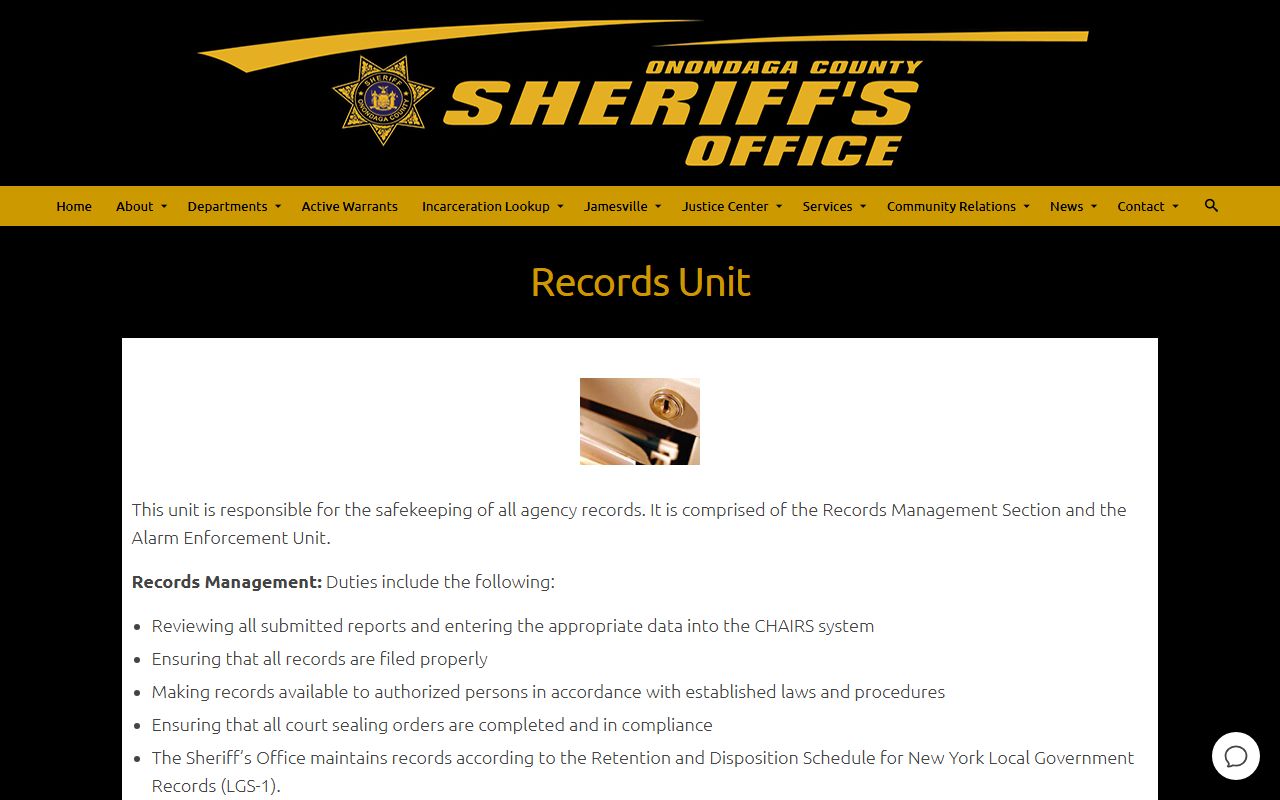
The Civil Records Unit and the arrest-records functions are separate divisions within the Onondaga County Sheriff's Office; each handles a distinct category of public records.
Charges vs Convictions in Onondaga County
The charge on a booking sheet is an allegation. It reflects what the arresting officer suspected at the moment of arrest, not what a court later found. New York prosecutors and defense attorneys regularly negotiate pleas that reduce or replace the original charge. A felony arrest can resolve as a misdemeanor plea. A misdemeanor arrest can end in a violation or an adjournment in contemplation of dismissal. An ACD, if the person completes conditions, results in dismissal and sealing under New York law. The booking sheet does not update to track those later changes.
The distinction matters for background checks, licensing, and immigration. A person who wants to know the legal outcome of a case should not stop at the booking record. The court docket shows what the case became, not just what it started as. For employment, housing, and licensing decisions that turn on a criminal record, a certified certificate of disposition from the issuing court is the document that counts. Requests go to the court clerk who handled the case, whether that was County Court at 401 Montgomery Street or Syracuse City Court at 505 South State Street. The County Clerk charges $5.00 per name per two-year period for a court records search.
Charges vs Convictions. The charge at booking shows what police suspected. The disposition in the court record shows how the case ended. For any purpose with legal consequences, use the certified disposition from the court clerk, not the arrest log.
Onondaga County Sheriff Incident and Accident Reports
Arrest records are not the only records the Onondaga County Sheriff's Office maintains. Accident and incident reports are a related category that often connects to arrest and criminal records. A DWI stop, for example, produces both an incident report and an arrest record. The two documents describe the same event from different angles. The incident report captures the officer's observations, the scene, and the parties involved. The arrest record captures what happened at booking. Both may be relevant when someone is trying to understand the full record of a criminal event in Onondaga County.
The Sheriff's Office accepts requests for accident and incident reports through its online process. The page for those requests is at sheriff.ongov.net/accident-incident-reports/.
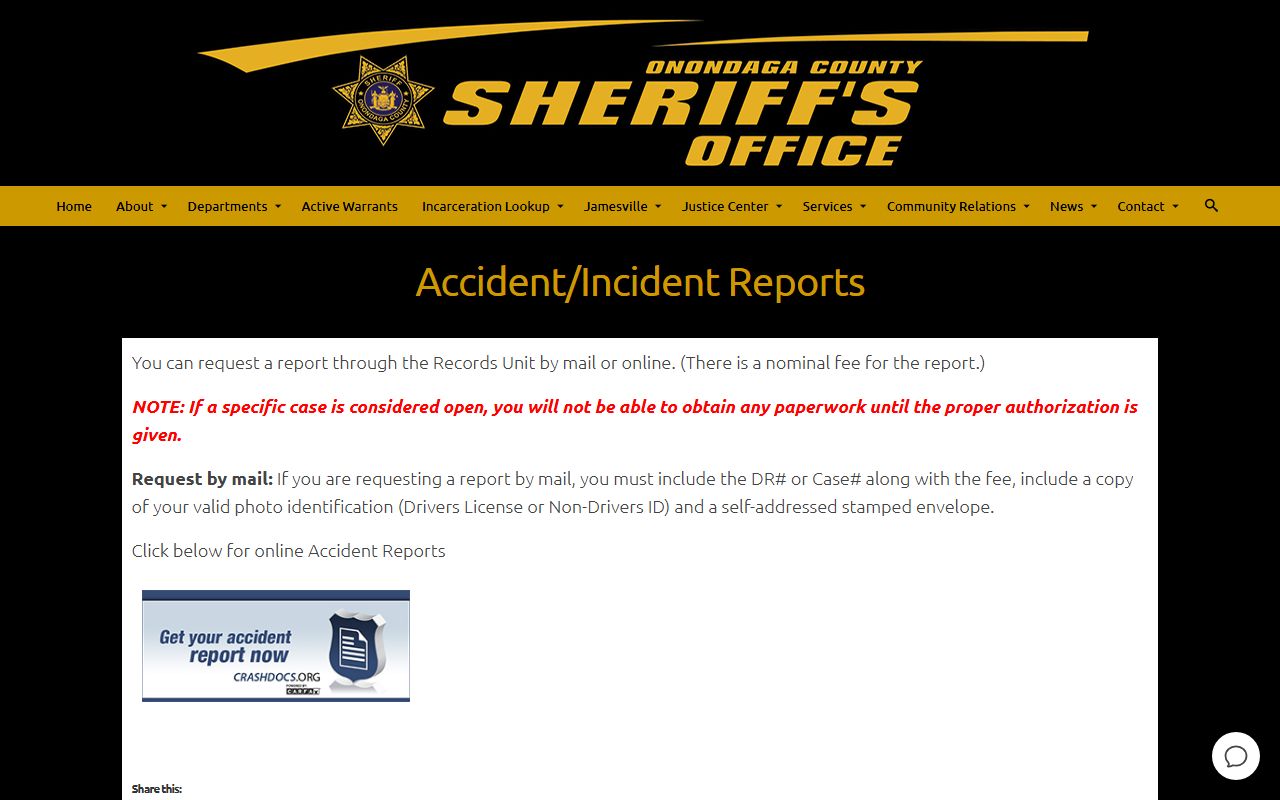
Incident report requests through this Sheriff's page are separate from court-record requests and County Clerk certified-copy requests; each goes to a different office and follows different rules and fees.
DWI and DUI arrests are criminal matters. They route to County Court or Syracuse City Court criminal parts and are handled by the Onondaga County District Attorney's Office at 505 South State Street. For DWI record details and how traffic violations connect to criminal proceedings, the traffic court records page covers that overlap in full.
Onondaga County Sheriff Background Checks
A background check is not the same as a county arrest log. The Onondaga County Sheriff's Office offers a background check service through its own channel, separate from the public incarcerated-individual lookup. The background-check page is at sheriff.ongov.net/services/background-checks/. That page sets out what the Sheriff checks, the applicable fee, and who can request it. This service pulls from what the local agency has on file, which is not the same as a full criminal history from the state.
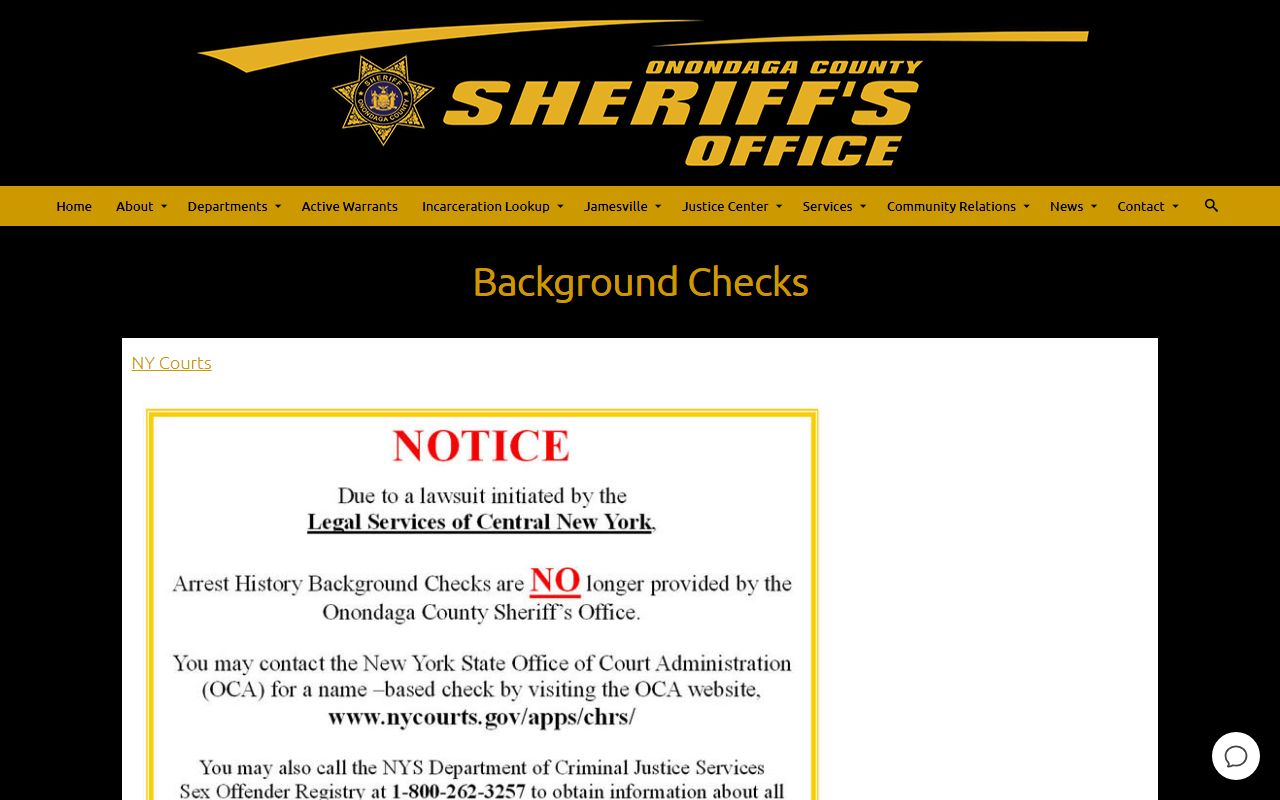
A Sheriff-issued background check reflects what the local agency has on file; it does not pull from every court in New York or from the full DCJS criminal-history database.
A DCJS criminal history is the most complete New York state criminal-history source. DCJS collects arrest and disposition data from law-enforcement agencies across the state. The Onondaga County Sheriff and other local agencies submit fingerprint-based data to DCJS. For employment-related or licensing-related background check purposes where a full criminal history is required, the DCJS report through an authorized channel is the right document. New York's Division of Criminal Justice Services site covers state criminal-justice records and the sex offender registry.
Note: Using an arrest record for hiring or tenant screening can conflict with the federal Fair Credit Reporting Act and New York's own Article 23-A employment-screening protections. An arrest that ended in dismissal or a sealed disposition should not be treated as proof of wrongdoing.
Sealing of Onondaga County Arrest and Criminal Records
New York seals eligible records rather than expunging them. The practical effect is that a sealed record stops appearing in public portals like WebCrims, but the underlying file still exists and remains accessible to law enforcement, prosecutors, courts, and some licensing agencies. Sealing is not the same as a clean record in every context. Three statutes drive most sealing in Onondaga County criminal cases.
CPL § 160.50 is the broadest seal. When a criminal action ends in favor of the accused, which includes dismissal, acquittal, and certain other favorable terminations, the court orders sealing. The arrest record, court docket, and related documents are sealed at that point. This happens automatically on a favorable outcome; the defendant does not have to file a separate motion to trigger it.
CPL § 160.55 covers cases that end in certain noncriminal dispositions, such as a violation conviction where the underlying charge was a crime. The sealing is narrower than 160.50 but still removes the matter from public criminal history in defined circumstances. CPL § 160.59 is the application-based sealing statute for eligible older convictions. A person with one or two eligible convictions and no subsequent felonies may apply to the court for sealing after a ten-year waiting period, subject to offense-type exclusions. This seal does not happen automatically and requires a formal court application.
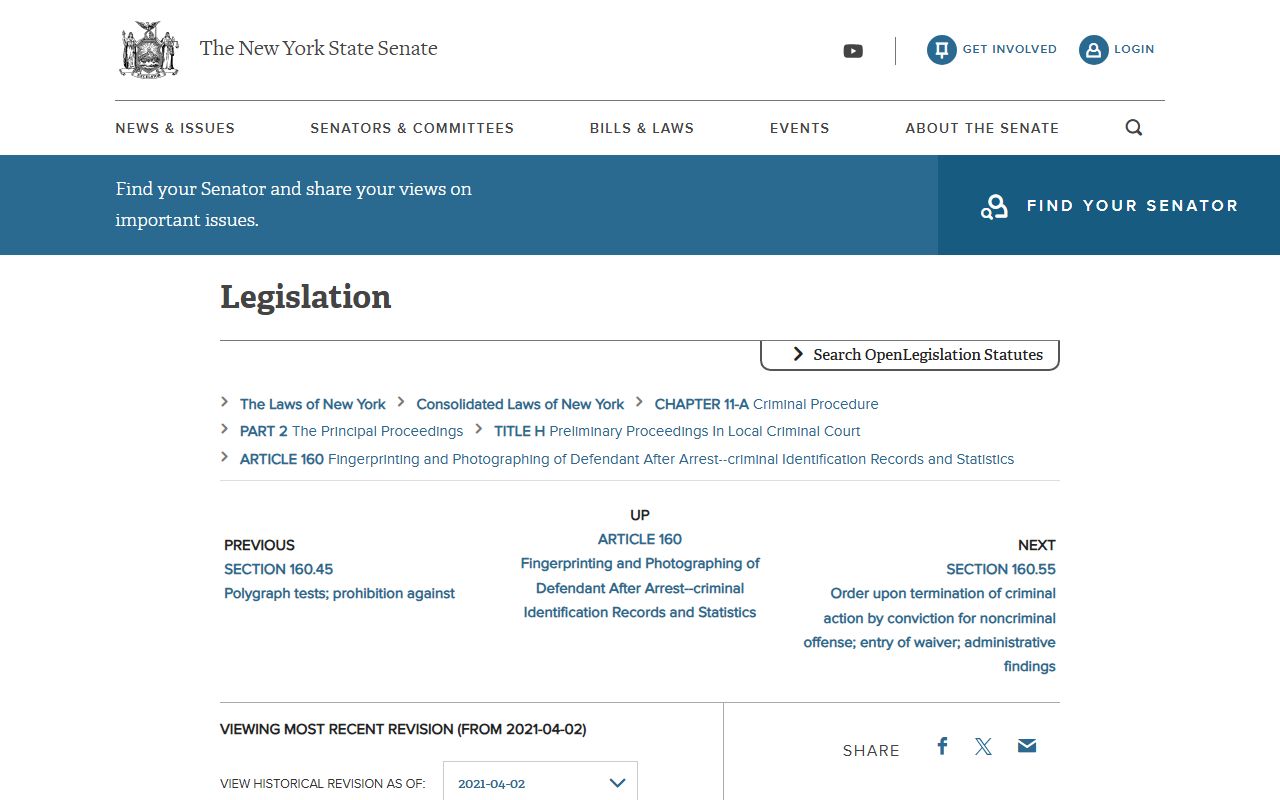
CPL 160.50 is the most common sealing path in Onondaga County; cases dismissed at arraignment or after trial seal automatically under this statute without the defendant needing to take further action.
| Sealing Path | Statute | Trigger | Who Can Still See It |
|---|---|---|---|
| Sealing after favorable termination | CPL 160.50 | Automatic on dismissal, acquittal, other favorable outcome | Law enforcement, prosecutors, courts, some licensing agencies |
| Sealing after noncriminal disposition | CPL 160.55 | Automatic when criteria met | Law enforcement and defined agencies |
| Application-based sealing | CPL 160.59 | Court application after 10-year wait | Law enforcement, courts, some licensing agencies |
| Youthful offender confidentiality | CPL 720.35 | Automatic upon YO adjudication | Authorized agencies only |
New York's Clean Slate Act adds a layer of automatic sealing for certain eligible convictions after statutory waiting periods. Verify current effective dates and exceptions against official New York sources before relying on Clean Slate protections, because the law is relatively new and implementation details continue to develop.
Public vs Restricted Arrest Records in Onondaga County
Not every Onondaga County criminal record is open to public inspection. New York law creates several protected categories that a public portal search will not return, and that a clerk cannot release without a court order or statutory authorization. Understanding these limits saves time when a search comes back empty.
Juvenile delinquency and PINS proceedings in Family Court are restricted under Family Court Act rules. These are not adult criminal cases, and the records are not available through WebCrims or any public criminal portal. Youthful offender cases, where a young adult defendant is adjudicated as a youthful offender rather than as a convicted adult, are confidential under CPL 720.35. These cases will not appear in a standard public search even if the arrest was reported publicly at the time it occurred.
- Juvenile delinquency records (Family Court Act rules).
- PINS proceedings and abuse/neglect cases in Family Court.
- Youthful offender adjudications (CPL 720.35).
- Cases sealed after favorable termination (CPL 160.50).
- Cases sealed after noncriminal disposition (CPL 160.55).
- Cases sealed by application (CPL 160.59).
- Sealed indictments and grand jury materials.
A blank result in WebCrims or the Sheriff's lookup does not mean a case never happened. It may mean the case is sealed, in a court not fully indexed by the portal, or listed under a different name spelling or docket format. For matters where a criminal history is legally required, a certified DCJS report through the proper channel is the only complete source.
Note: Sealed records remain accessible to law enforcement, courts, and certain licensing agencies; sealing removes a record from public view but does not create a clean slate in every context.
Onondaga County Criminal Court Records
Criminal court records in Onondaga County sit in two main portals after a case is filed. WebCrims handles criminal case appearances for County Court, Syracuse City Court, and a range of other courts. NYSCEF handles electronically filed documents in Supreme and County Court matters. Neither portal is a comprehensive criminal-history database; both are case-tracking tools that show court dates, charge information, and status where public.
WebCrims searches by defendant name or docket number. Selecting Onondaga County as the county filter narrows results to local cases. The portal shows the court assigned, the judge or part, upcoming appearance dates, charges as filed, and the general case status. It does not show sealed cases, youthful offender matters, or cases from courts not indexed. The WebCrims defendant search is the official entry point for criminal appearance lookups.
For older case files, certified dispositions, and records that did not move through electronic filing, the Onondaga County Clerk at 401 Montgomery Street, Room 200, is the right office. The Clerk holds filing responsibility for Supreme and County Court records in Onondaga County and issues certified copies under Judiciary Law § 255 for the fee schedule posted at onondaga.gov/clerk/fees/. A court records search runs $5.00 per name per two-year period. Full detail on all court portals and what each record type contains lives on the Onondaga County court records page.
Active Warrants and Onondaga County Arrest Records
An active warrant is related to but distinct from a prior arrest record. A bench warrant is issued when a defendant misses a court date. An arrest warrant is issued when a court finds probable cause for an arrest that has not yet happened. Either can result in a new booking event at the Justice Center, adding to an individual's arrest history in Onondaga County.
The Onondaga County Sheriff publishes a public active-warrant search at sheriff.ongov.net/awarrants/. This is one of the few county warrant searches in New York that is publicly accessible online without contacting the court directly. Sealed warrants, juvenile matters, and investigative warrants will not appear there. For the full picture on warrant types, resolution steps, and what to expect if a warrant is discovered, the Onondaga County warrant records page covers those topics in depth.