
Marriage Licenses in Onondaga County
Marriage licenses in New York are issued by town and city clerks, not the County Clerk. In Onondaga County, a couple applies to whichever town or city clerk serves the municipality where they choose to apply within the state. If both parties live in the City of Syracuse, the Syracuse City Clerk issues the license. For couples in the county's towns and villages, the issuing clerk depends on where the couple goes to apply. The Onondaga County Clerk publishes a town and village clerk contact list to help people locate the right office quickly.
Both parties must appear together in person. Each applicant brings proof of age and identity as required by state law. New York does not require a blood test. A 24-hour waiting period runs from the time the license is issued before the ceremony can take place, unless a judge grants a judicial waiver. The license is valid for 60 days after issue. For active military, that window is 30 days. After the ceremony, the officiant returns the completed license to the issuing clerk for recording. A couple cannot obtain a certified marriage record until the completed license is filed.
Confirm current appointment requirements and fee amounts with the specific town or city clerk before going in. Those details vary by municipality and can change without advance notice.
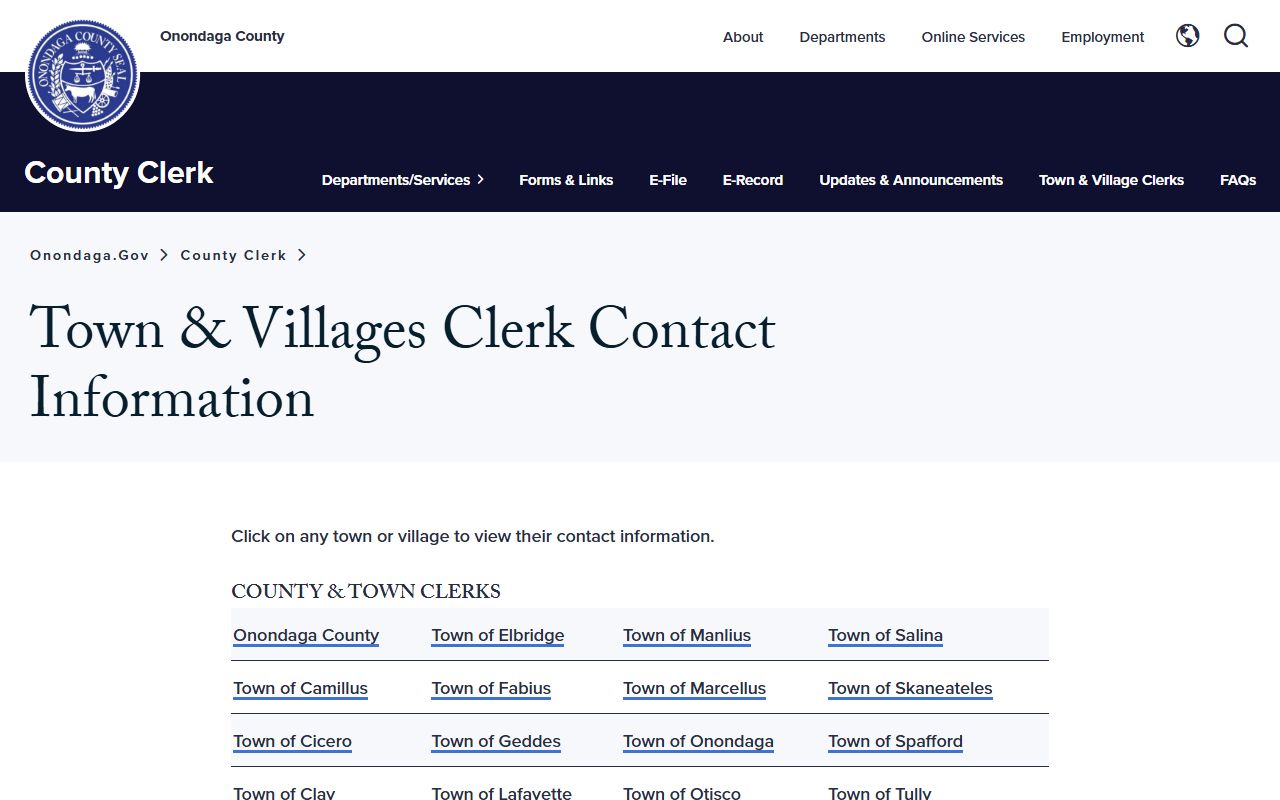
The Onondaga County Clerk's town and village clerk directory lists the offices that handle marriage license applications for each municipality in the county.
How to Apply for a Marriage License
New York's marriage license process has a defined order. The 24-hour waiting period is mandatory under state law, and skipping or reversing steps causes delays. The steps below follow the standard New York procedure as it applies in Onondaga County municipalities.
- Identify the correct town or city clerk using the Onondaga County Clerk's town and village clerk list. For Syracuse residents, contact the Syracuse City Clerk.
- Check whether the office requires an appointment. Some clerks take walk-ins; others do not. Call ahead to confirm.
- Both applicants appear together and bring government-issued proof of age and identity. Anyone previously married brings proof that the prior marriage ended, such as a divorce decree or death certificate.
- Complete the marriage license application at the clerk's office and pay the license fee. The clerk witnesses the signing.
- Wait the full 24-hour period required by New York before holding the ceremony. A court can waive this in limited cases on a showing of good cause.
- Have the ceremony performed by an authorized officiant within the 60-day validity window. Active military have 30 days from the issue date.
- Confirm that the officiant returns the completed license to the issuing clerk for recording. A ceremony that produces no filed license leaves no official record.
- Request a certified marriage record from the issuing clerk once the completed license is on file. This is the document most agencies, courts, and government offices accept.
If an officiant does not return the completed license promptly, follow up in writing. No certified copy can be issued from a record that has not been filed with the clerk.
Marriage License Application Fields
The New York marriage license application collects identity and prior-marriage information from both applicants. A couple with a prior marriage needs to be prepared to explain how that marriage ended. The table covers the fields both parties should expect to provide when they appear at the clerk's office in an Onondaga County municipality.
| Field | Type | Required | Notes |
|---|---|---|---|
| Applicant 1 name | text | yes | Full legal name as it appears on identification. |
| Applicant 2 name | text | yes | Full legal name as it appears on identification. |
| Address | text | yes | Current residence address for each applicant. |
| Date of birth / age | date | yes | Proof of age required at the clerk's office. |
| Place of birth | text | yes | State or country of birth. |
| Parent information | text | yes | As required by the New York application form. |
| Prior marriage information | text | conditional | Divorce or death details if either applicant was previously married. |
| Identification presented | checkbox | yes | Government-issued photo ID and any supporting proof documents. |
| Fee / payment | payment | yes | Amount set by the issuing town or city clerk; confirm before visiting. |
| Signature / oath | signature | yes | Both applicants sign under oath before the clerk. |
Bring more proof than you think you need. Clerks can turn away applicants who arrive without the right documents, and the 24-hour waiting period clock does not start until the license is actually issued.
Onondaga County Office of Vital Statistics
Birth and death certificates for Onondaga County are maintained by a separate office, not the courts or the County Clerk. The Onondaga County Office of Vital Statistics handles these records and processes certified copy requests. The office is at 421 Montgomery Street, Civic Center Suite 20, Syracuse, NY 13202, phone (315) 435-3241, and is open Monday through Friday, 9:00 a.m. to 4:00 p.m. The official page is onondaga.gov/vital.
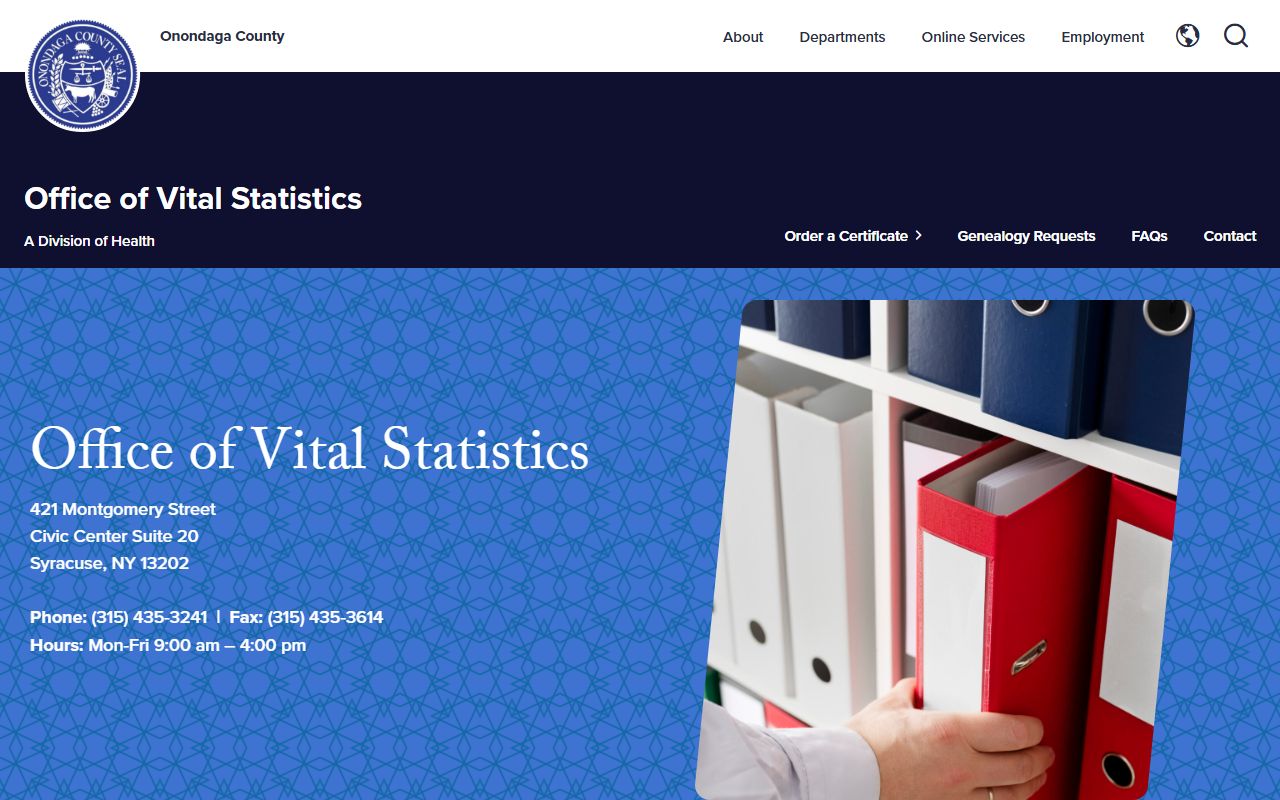
The Onondaga County Office of Vital Statistics page is the official source for birth and death certificate requests, eligibility rules, and instructions for who may request a certified copy.
Marriage and divorce records follow a different path. A certified marriage record comes from the issuing town or city clerk. A certified divorce judgment comes from the Supreme Court or the Onondaga County Clerk. The New York State Department of Health may also issue divorce certificates to eligible persons through its vital-records process, which is separate from the court file. The two documents cover different needs: the state certificate is a short proof of dissolution, while the court file holds the full case documents and is the record most legal proceedings require.
Onondaga County Vital Records Fee Schedule
Onondaga County charges set fees for vital record copies. Birth and death certificate fees are verified from the Onondaga County Office of Vital Statistics. County Clerk certified copy fees are verified from the Onondaga County Clerk fee schedule. Marriage certificate fees vary by the issuing town or city clerk; contact that office for the current amount.
| Record Type | Fee | Office |
|---|---|---|
| Birth certificate (certified copy) | $30.00 each | Onondaga County Office of Vital Statistics |
| Additional birth certificate copies ordered together | $15.00 each | Onondaga County Office of Vital Statistics |
| Death certificate (certified copy) | $30.00 each | Onondaga County Office of Vital Statistics |
| Additional death certificate copies ordered together | $15.00 each | Onondaga County Office of Vital Statistics |
| Court records search (certified) | $5.00 per name, per 2-year period | Onondaga County Clerk |
| Certified copy (first 4 pages) | $5.00 minimum | Onondaga County Clerk |
| Certified copy (per page after 4) | $1.25 per page | Onondaga County Clerk |
| Exemplified copy | $10.00 additional | Onondaga County Clerk |
| Marriage certificate / license | Varies by municipality | Issuing town or city clerk |
Note: Town and village clerk fees for marriage licenses are set by each municipality and are not uniform across Onondaga County. Confirm the current fee with the specific issuing clerk before submitting an application or request.
Onondaga County Divorce Records
Divorce in New York is a Supreme Court matter. Onondaga County Supreme Court at 401 Montgomery Street, Syracuse, is the trial court where divorce actions are filed in the county. That surprises some people who expect divorce to sit in Family Court. Family Court deals with custody, support, family offense, and related matters, not the divorce itself. Divorce belongs in Supreme Court, and Onondaga County is part of the Fifth Judicial District.
The central access rule is Domestic Relations Law § 235, which restricts public inspection of matrimonial records. A divorce file is not browsed the same way an ordinary civil tort case is. A third-party searcher may be able to confirm that a case exists using an index number, but the underlying pleadings and financial documents are generally not open to someone who is not a party or an attorney of record. The privacy rule exists to protect sensitive personal and financial information that matrimonial cases routinely contain.
Divorce produces several documents, and access differs by type. The judgment of divorce is often the most accessible part of the file for parties who need proof of dissolution.
- Summons and complaint or summons with notice.
- Verified pleadings and affidavits.
- Settlement or separation agreement.
- Child-support and custody papers where applicable.
- Judgment of divorce and findings of fact.
- Certificate of dissolution.
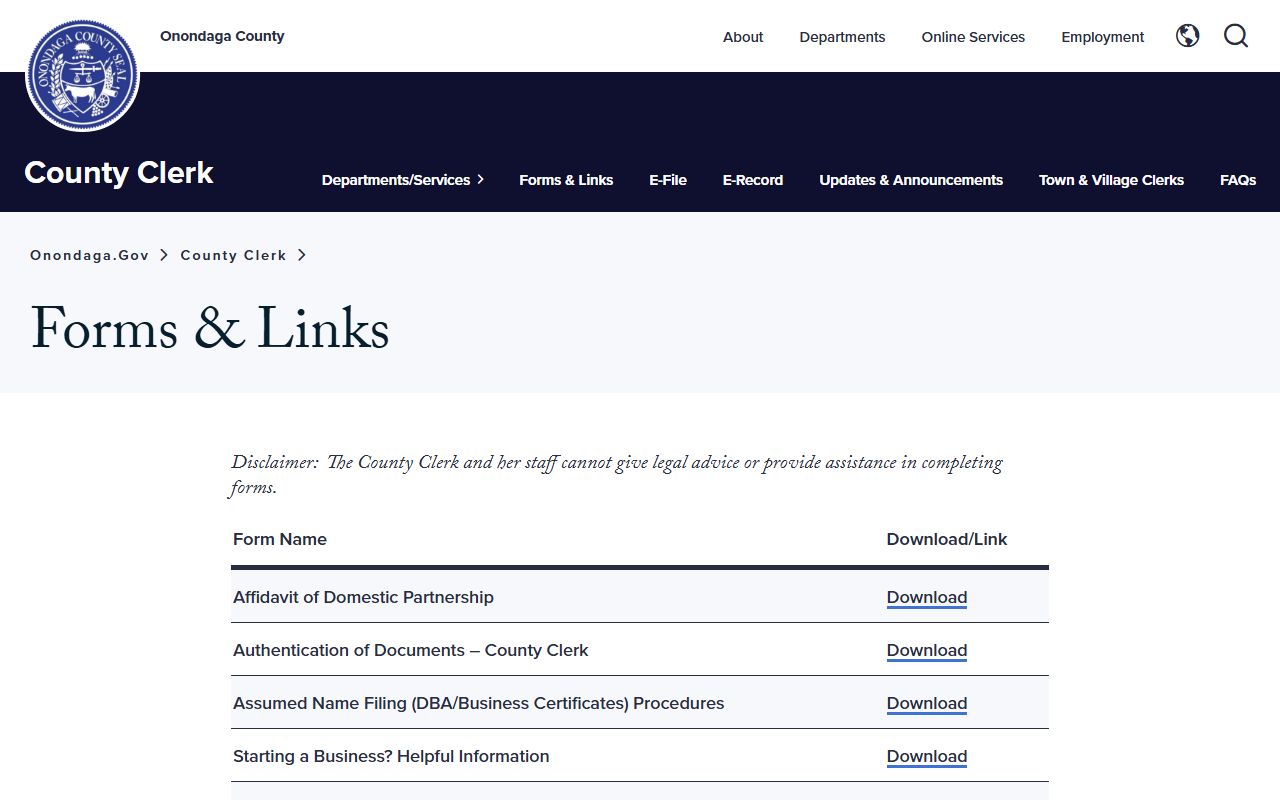
The Onondaga County Clerk forms page includes a divorce file request that parties can use to begin the process of requesting certified divorce documents through the county court.
Searching for an Onondaga County Divorce Case
Because matrimonial records in New York carry privacy restrictions, a divorce search works differently from a regular civil case lookup. The best identifier is the index number the Supreme Court assigned when the case opened. A party who has the index number can confirm the case and request documents through proper channels. A member of the public searching by name should expect limited results. The restrictions under Domestic Relations Law § 235 keep matrimonial pleadings and exhibits out of ordinary public view. The Onondaga County Clerk forms page has a divorce file request for parties who need to submit a formal copy request through the county office.
| Field | Type | Notes |
|---|---|---|
| Index Number | text | Best identifier for a Supreme Court divorce. Assigned at filing. |
| Party name | text | Public name search is limited by DRL 235; results may be restricted. |
| County | dropdown | Select Onondaga. |
| Case type | dropdown | Matrimonial category may be restricted in public portals. |
| Document access | login / court order | Many matrimonial documents require party status or a court order to inspect. |
For a certified divorce judgment, a party submits a request through the County Clerk or the court clerk. Eligible persons may also request a divorce certificate from the New York State Department of Health through its vital-records channel. Those two routes serve different needs. The court file holds the full case record. The state certificate is a short proof of dissolution that does not expose the underlying pleadings.
Certified judgment vs. certificate of dissolution. A certified divorce judgment comes from the court file and is the document that most agencies, employers, and government offices accept as proof. A certificate of dissolution is a short administrative record from the New York State Department of Health. Confirm which form the requesting agency needs before placing an order.
How a Divorce Is Filed in Onondaga County
A divorce case in Onondaga County follows a set path through Supreme Court. New York allows no-fault divorce based on an irretrievable breakdown of the marriage lasting at least six months, as well as traditional statutory grounds. Most cases filed today use the no-fault ground. Self-represented filers can use the New York Courts CourtHelp portal and the official forms library for uncontested divorce packets. The public records page explains why a divorce file requires a court-record request rather than a FOIL request, which is a common point of confusion.
- Confirm that at least one spouse meets New York residency requirements for a divorce filed in Onondaga County.
- Select grounds, including the no-fault irretrievable-breakdown ground or a statutory fault ground.
- Prepare the summons, complaint, and supporting papers. An uncontested divorce typically includes a settlement agreement covering property, support, and custody where children are involved.
- File in Supreme Court through the county clerk's civil division or through NYSCEF where e-filing is required. An index number is assigned at filing and is the key identifier for the case.
- Serve the other spouse following New York service-of-process rules. Proof of service must be filed.
- Resolve all open issues, including custody, child support, spousal maintenance, and property division.
- Submit the judgment package for an uncontested divorce, or proceed through conferences and trial for a contested one. The judge signs the judgment and the clerk enters it. The case is then disposed.
Family Court vs. Supreme Court in Onondaga County
Custody and child support can live in Onondaga County Family Court, in a Supreme Court divorce case, or in both over time. A divorced parent may have a Supreme Court judgment and later file petitions in Family Court to modify or enforce custody or support orders. A complete record search sometimes has to cover both systems. Family Court records are restricted under the Family Court Act, so public access there is even more limited than in Supreme Court divorce files.
| Matter | Court | Access |
|---|---|---|
| Divorce | Supreme Court | Restricted under Domestic Relations Law 235. |
| Custody / visitation | Family Court or Supreme Court | Family Court files are confidential under the Family Court Act. |
| Child support | Family Court or Supreme Court | Limited public access; financial information protected. |
| Marriage license | Town or city clerk | Certified copy available from the issuing clerk by request. |
| Birth / death certificate | Onondaga County Office of Vital Statistics | Available to eligible requesters; fees apply. |
Note: A record history that spans a divorce plus later custody or support modifications may require searching both Onondaga County Supreme Court and Family Court, which use separate clerk systems.
Can I read someone else's Onondaga County divorce file?
Usually not. Domestic Relations Law 235 limits public access to matrimonial records in New York. A public searcher may be able to confirm that a case exists using an index number, but the pleadings, affidavits, and financial documents are generally closed to anyone who is not a party or their attorney. A certified judgment of divorce or a certificate of dissolution is the document typically available to satisfy proof needs outside of the case.