
Onondaga County Jail Roster and Inmate Lookup
The Onondaga County Sheriff's Office runs two public incarcerated-individual lookups. The Justice Center lookup covers the downtown pretrial facility. The Correction Department lookup covers the sentenced population at Jamesville. Both tools are free and need no account. They are also distinct, so searching one will not return results from the other. If you do not know which facility holds the person, run both searches.
The Justice Center lookup shows individuals in pretrial detention at the Patrick J. Corbett Justice Center in downtown Syracuse. Results reflect current custody, so a person released this morning may no longer appear.
The search fields for both county roster tools are simple. Last name is the main entry point. A first name or booking number narrows results when multiple people share a surname. The table below reflects the confirmed field inventory for both portals.
| Field Label | Type | Required | Notes / Format |
|---|---|---|---|
| Last Name | Text | Usually required | Incarcerated individual surname. Use exact spelling first; try partial if no result appears. |
| First Name | Text | Optional | Narrows results when the surname is common. |
| Booking / ID Number | Text | Optional | Exact lookup when a booking number is known from prior paperwork. |
| Search / Reset | Button | n/a | Runs or clears the query. |
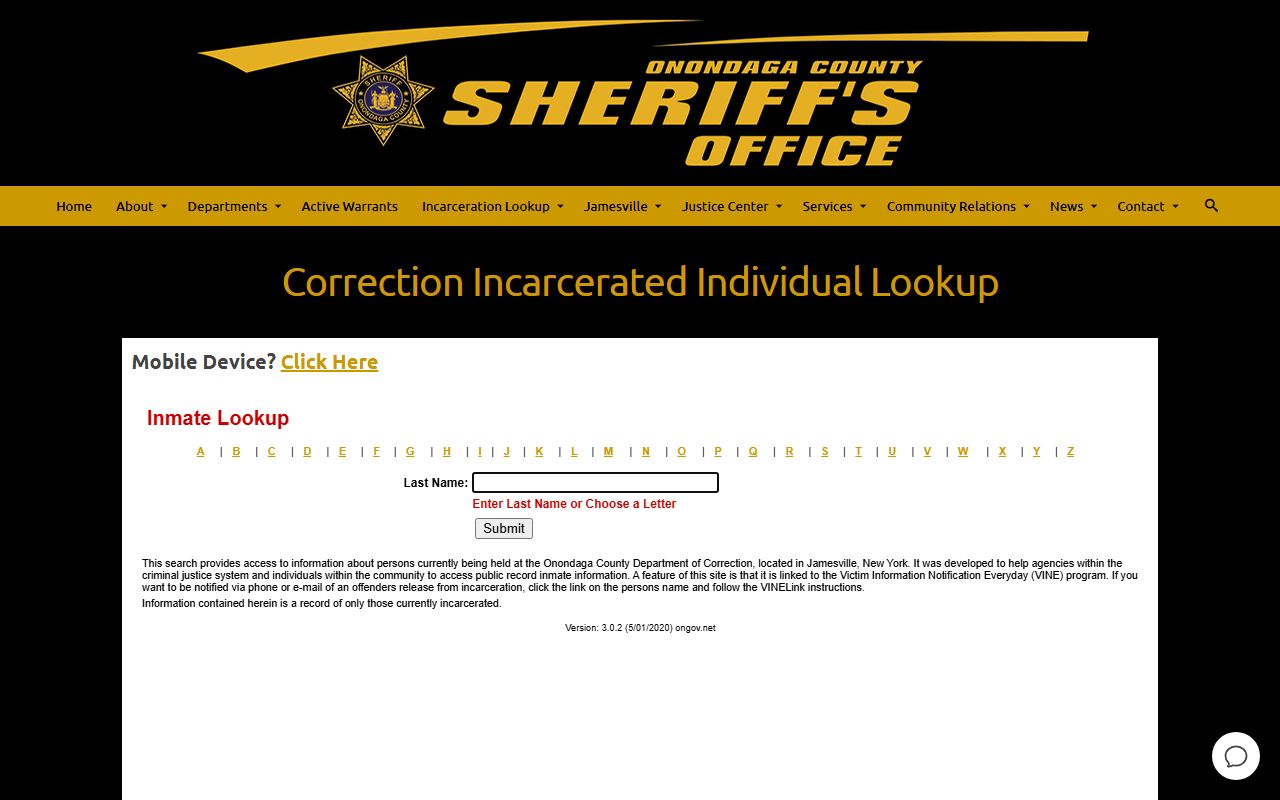
The Correction Department lookup covers Jamesville Correctional Facility, where sentenced individuals serve local terms. A person who has been sentenced and transferred from the Justice Center will appear here rather than in the Justice Center tool.
How to Use the Onondaga County Jail Roster
The lookup is simple to run, but a few steps improve results and avoid confusion. Custody data updates as intake and release events happen, so a search run at different times of day can return different results for the same person. A recent arrest may not show up for several hours while booking is still in progress at the facility.
- Go to sheriff.ongov.net/lookup/ for the Justice Center or sheriff.ongov.net/correction/lookup/ for Jamesville. Open both if you do not know which facility applies.
- Enter the last name. Use the exact spelling as it appears on the person's government ID, since booking records are keyed to the name recorded at intake.
- Add the first name to narrow results when the surname is common or shared with many others.
- If you have a booking number or facility ID from prior paperwork, use that field for an exact match instead of a name search.
- Review the result list. Confirm the full name, facility, and booking date match the person you are looking for before acting on the result.
- If no result appears, the person may have been released, transferred, or not yet processed through intake. Wait a few hours after a very recent arrest before concluding the person is not in county custody.
- If you still cannot confirm status after checking both tools, call the Sheriff's corrections line or register on VINELink New York to receive a notification when custody status changes.
A missing result is not proof someone was never arrested. It can mean a very recent booking is still being processed, a transfer happened before the search, or the matter is in a different system entirely. State prison and federal custody are each separate from the county roster.
Onondaga County's Two Custody Facilities
Most counties in New York run one local jail. Onondaga County runs two, and their roles are distinct. The Patrick J. Corbett Justice Center is the pretrial facility for people not yet sentenced. Jamesville Correctional Facility handles sentenced individuals serving local jail terms. Knowing which facility applies tells you where to look and who to call.
Patrick J. Corbett Justice Center
555 South State Street
Syracuse, NY 13202
Role: Pretrial detention, county jail
Jamesville Correctional Facility
6660 East Seneca Turnpike
Jamesville, NY 13078
Role: Sentenced local inmates
The Justice Center sits in downtown Syracuse, a few blocks from the Criminal Courthouse at 505 South State Street where arraignments and criminal proceedings happen. Most people arrested in Onondaga County pass through the Justice Center first. If a judge sentences someone to a local jail term rather than state prison, they typically move to Jamesville to serve that term. Both facilities are operated by the Onondaga County Sheriff's Office through separate Custody and Correction divisions. Neither is a state prison, and neither feeds into the state DOCCS system automatically.
Both facilities appear in VINELink New York for notification purposes. Victims and family members can register for alerts when custody status changes at either location without needing to check the roster repeatedly.
What an Onondaga County Inmate Record Shows
The county lookup returns a profile for each person in custody. The profile is a custody-status record, not a full criminal history. Those are two different things. A booking record captures the intake event. A criminal record captures the full arc of charges, court proceedings, and final outcomes. Use the state court portals for conviction and sentencing details.
| Field | What It Shows |
|---|---|
| Full Name | Legal name as recorded at booking; may include aliases used at intake. |
| Custody Status | Whether the person is currently held, released, or transferred to another facility. |
| Facility | Justice Center (pretrial) or Jamesville Correctional Facility (sentenced). |
| Booking Date | Date and time of intake where the information is public. |
| Charges or Case Number | Charge description or court case reference where public and available. |
| Agency | Law-enforcement agency that made the arrest and brought the person to intake. |
| Release Notification | Whether VINELink alerts are available for this individual at this facility. |
Fields that are not reliably public include medical status, protective custody classification, detailed housing unit location, suicide-risk screening results, and any juvenile or minor information. If someone is in protective custody or has a sensitive classification, staff may decline to confirm housing details even when general custody is confirmed. That is a security call, not a problem with the search. Court outcomes and conviction status must be checked through the court or a certified disposition, not the jail roster. The Onondaga County court records page explains how to get certified documents from the clerk.
Booking at the Onondaga County Justice Center
After an arrest in Onondaga County, a person is transported to the Patrick J. Corbett Justice Center for intake. The booking process runs through several steps before a person is placed in a housing unit or released on any conditions the court may set. Booking does not mean conviction. It means a person has been formally taken into custody on a charge, and that charge still has to move through the courts before any final outcome is reached.
- Identity verification: fingerprints and a booking photograph are taken and logged in the system.
- Property inventory: personal items, cash, and clothing are documented and stored or flagged as evidence.
- Medical and mental-health screening: all new admissions are screened, including a suicide-risk assessment required by New York law.
- Classification: a scoring process determines the housing level, supervision needs, and any special housing requirements for this individual.
- Housing assignment: the person is placed in a unit based on classification, current population, and available space at the Justice Center.
- Court notification: the court is notified so arraignment can be scheduled in line with New York's arraignment-timing rules.
In Onondaga County, arraignment timing depends on when the arrest happened, which court covers the charge, and the court's calendar. A person arrested in the City of Syracuse is usually arraigned in Syracuse City Court at 505 South State Street. A town or village arrest routes to that municipality's justice court. Felony charges, after a grand jury indictment or superior-court information, move to Onondaga County Court at 401 Montgomery Street. At arraignment, a judge sets bail or release conditions under New York bail law, and the jail releases a person only after the court order is received, any payment or conditions are cleared, and warrant checks come back clean.
A person who passes through booking and is released at arraignment on recognizance may process quickly and not appear in the online lookup at all. A very recent arrest that does not show in the roster may still be mid-booking at the facility.
Holds, Detainers, and Why Bail Does Not Always Mean Release
One of the most common points of confusion in Onondaga County custody is the gap between posting bail and actually getting out. Bail payment handles the local case. A hold or detainer from a separate matter keeps the person in custody regardless of what happens on the charge that triggered the current booking. These holds come from sources outside Onondaga County's control, which is why the jail cannot always release a person immediately even after bail is paid.
Holds and detainers arrive from several directions. Another Onondaga County court may have an open case with its own bail condition or a bench warrant attached. A warrant from a different county or state can flag during the warrant check that runs before every release. A parole or probation violation can produce a hold from the state Department of Corrections and Community Supervision or from a local supervision officer. An out-of-county agency may request a hold for transfer on a separate charge. In any of these situations, posting bail on the original Onondaga County case does not end custody. The hold from the other matter stays in place until that agency acts.
Families who have posted bail and are waiting on release should contact the Sheriff's Office or defense counsel to find out specifically what hold is in place. The jail can usually identify which agency filed the detainer. The details of that hold belong to the requesting agency, not Onondaga County. The released inmates page covers release verification, reentry steps, and what happens when a hold finally clears.
Release after a judge's order also takes time. The process runs in sequence: the court order is received, the warrant check is completed, payment is confirmed if bail was cash or bond, any supervision-condition paperwork is processed, and property is returned. Even a smooth release can take several hours from the moment a judge signs the order to the moment a person walks out.
County Jail, State Prison, and Federal Custody
The Onondaga County jail roster covers only individuals in county custody at the Justice Center or Jamesville. It does not overlap with state prison or federal custody records. Knowing which system holds the person is the first step in any search, because using the wrong tool will always return nothing even if the person is in custody somewhere else.
The New York Department of Corrections and Community Supervision maintains a free public lookup for people serving state prison sentences. A person convicted of a felony and sentenced to a state prison term moves out of Onondaga County custody into DOCCS. At that point they will no longer appear in the county lookup and will show instead in the DOCCS system. The DOCCS incarcerated individual lookup is at publicapps.doccs.ny.gov.
DOCCS search fields include DIN (Department Identification Number), NYSID (New York State Identification Number), last name, first name, and birth year. A DOCCS profile shows custody status, facility, admission date, crime of commitment, sentence length, and parole eligibility or release dates for people in state prison or on community supervision in New York.
Federal custody is a third system. People charged under federal law and held in federal facilities appear in the Bureau of Prisons locator at bop.gov/inmateloc/. A federal inmate temporarily housed in a county facility under a contract arrangement may or may not appear in both systems depending on how the agreement is structured. When in doubt, check all three systems: county, DOCCS, and BOP.
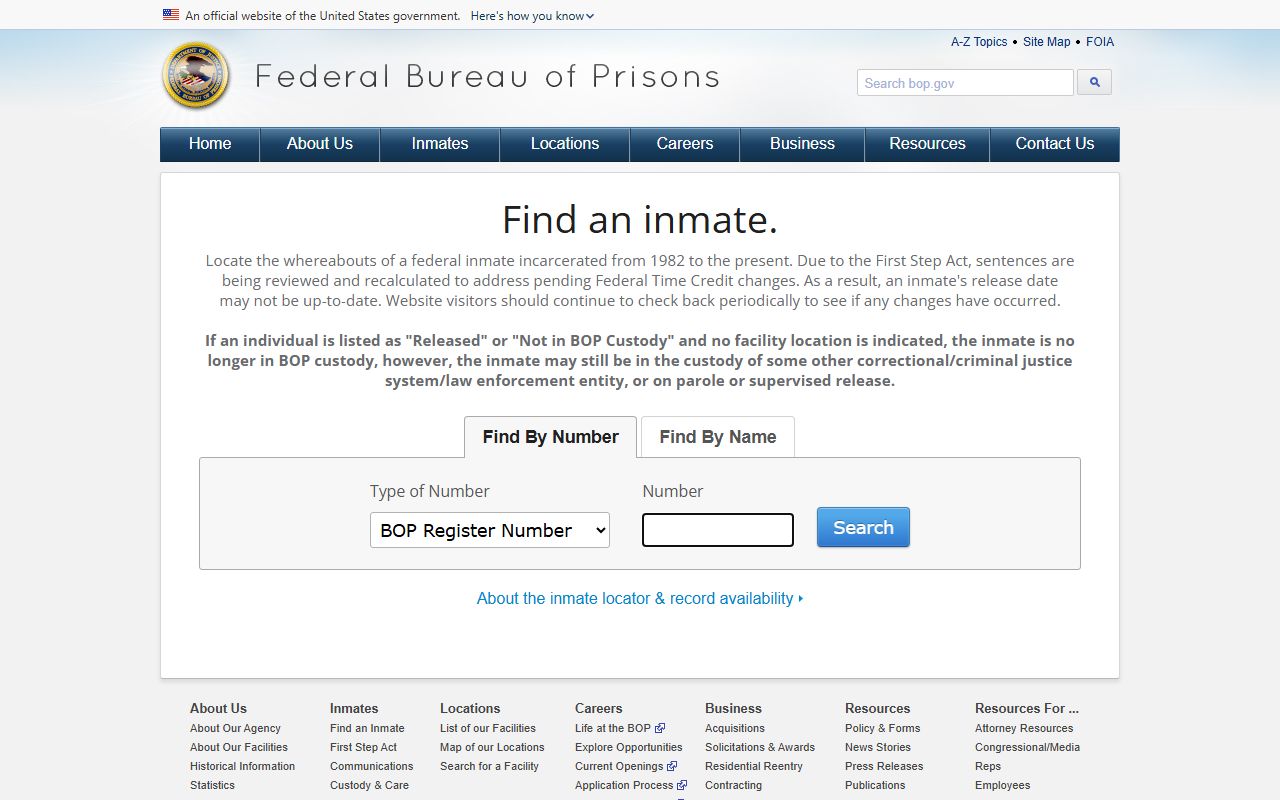
The BOP locator returns the federal register number, age, race, sex, release date or projected release, and the holding facility. It does not show Onondaga County charges or any local court matters. If a person is in federal custody on a federal charge, the county roster will show nothing because county custody ended when federal custody began.
VINELink Custody Notifications for Onondaga County
VINELink is a free notification service for victims, family members, and others who need to track custody status changes without manually checking the roster. A person registers once and receives an alert by phone or email whenever status changes at the facility, such as a release, transfer, or return to custody from a brief court appearance. The New York VINELink service covers Onondaga County facilities.

VINELink New York at vinelink.vineapps.com/state/NY lets users select New York, narrow to the Onondaga County facility, and search by name or offender ID. Once the person is found, the registration form asks for a phone number or email to send alerts. The service sends a notice when custody status changes, removing the need to check the roster by hand at intervals.
VINELink is a notification tool, not a court-record database. It does not show charges, case history, or sentencing data. For case information, use Onondaga County court records through the state court portals. Crime victims with a safety concern should register early rather than waiting until a release is already imminent or has already happened.
Note: VINELink notification depends on the county facility reporting status events to the system. There may be a lag between a physical release event and a system update. Confirm directly with the Sheriff's Office if an alert is time-critical and cannot wait for the system to catch up.
Visitation, Mail, and Money at Onondaga County Facilities
The Onondaga County Sheriff's corrections pages are the official source for all visitation, mail, and money rules. Those pages update when policies change. The overview below reflects what the official pages describe at the time of research, but specific times and requirements must be verified on the Sheriff's site before making a trip or sending anything to the facility.
The Sheriff's incarcerated individual visitation information page covers personal and video visit options, scheduling, ID requirements, approved-visitor rules, restrictions on minors, and any vendor or platform used for video visits. The Justice Center has referenced video visitation as an available option. In-person visits at both facilities require a valid government-issued photo ID. Rules on who is on the approved list, what clothing is permitted, and what to bring are set by each facility and can change without notice. Do not assume the rules are the same as a prior visit to a different facility or a visit that happened some months ago.
| Visit Type | Schedule | Requirements |
|---|---|---|
| Personal / in-person visits | Verify current schedule at sheriff.ongov.net/correction/inmate-visitation-information/ | Government photo ID required; approved-visitor list and dress-code rules as posted by the facility. |
| Video visits | Verify current schedule and platform on the official visitation page before using any vendor. | Use only the vendor or platform listed on the county page; do not assume a specific provider is accepted. |
| Attorney / professional visits | Arranged separately; verify on the corrections page or by calling the facility directly. | Professional identification and documentation of case relationship required. |
Mail and money rules appear on the money and property drop-off page. Mail addressed to an incarcerated individual should include the person's full legal name and booking number in the address line to make sure it routes to the correct housing unit. Some types of mail, packages, and items are not allowed. Confirm the current accepted-mail list before sending anything. Legal mail from defense attorneys is handled differently from personal mail and should be labeled as attorney-client correspondence so it moves through the correct channel under the facility's legal-mail rules.
Money deposits for commissary and phone accounts follow the method the facility currently accepts. Payment methods change over time, and unofficial third-party services may not be recognized by the county. Use only the method listed on the official Sheriff's corrections page or confirmed directly by calling the jail. For a fuller look at release procedures, money, and property return, see the released inmates page.
Warrants and Onondaga County Inmate Custody
Active warrants are among the most common reasons someone stays in custody after bail has been paid or a release order has been issued. Onondaga County is notable in New York for publishing a public active-warrant search alongside its public jail roster. The Sheriff's Office warrant search is at sheriff.ongov.net/awarrants/. Running that search at the same time as the jail roster can quickly show whether an open warrant is what is keeping a person held.
Types of warrants that affect custody include bench warrants from a failure to appear for a court date, arrest warrants issued in a new case by a court or grand jury, violation warrants from probation or parole supervision, and warrants from other counties or states that trigger an automatic hold when they flag during the release check. A bench warrant can also change bail conditions. A judge who issues a bench warrant may increase or revoke bail entirely, which changes the release math. The Onondaga County warrant records page covers the active-warrant search in full, including what the search fields look like, what results show, and the steps involved in clearing an outstanding warrant through the court.
Sealed warrants, sealed indictments, and warrants tied to active investigations will not appear in the public tool. If a warrant is suspected but does not show in the public search, counsel should check directly with the issuing court rather than assuming the public result is complete.
Inmate Record vs. Criminal Record in Onondaga County
A jail booking and a criminal record are two different things. The distinction matters for anything that touches a background check, an employment question, a licensing matter, or a legal proceeding. An inmate record is a custody record. It records that a person was brought into the facility, when intake happened, what facility holds them, and sometimes what charge was cited at booking. It does not record what the court decided. A criminal record captures the full path: charges, pleas, motions, trial, disposition, and sentence. The court holds that record, not the jail.
Does an Onondaga County jail booking prove a conviction?
No. A booking shows that a person was arrested and taken into custody. The case still has to move through the courts. The person may be acquitted, have the charges dropped, reach a plea, or be convicted at trial. For the outcome, request a certified disposition from the court that handled the case, or check WebCrims for the case status and next court date.
For employment background checks, immigration applications, professional licensing, or firearms eligibility questions, the authoritative source is a certified disposition from the issuing court or a certified criminal-history report from the New York Division of Criminal Justice Services, not the jail roster. The jail roster is a real-time custody tool. It is useful for family members trying to find someone who was just arrested. It is not a substitute for a criminal-history report.
New York sealing rules under CPL 160.50 and CPL 160.59 can restrict criminal-history records even when a person was once in county custody and appeared in the jail roster at the time of the arrest. A sealed case may no longer show in a public court portal even though the booking happened. Sealing questions belong with defense counsel or the court that handled the case. The Onondaga County arrest records page covers sealing rules in more depth, including how favorable terminations seal automatically and how eligible older convictions can be sealed by application.
A few custody terms come up whenever families call the facility. Knowing them helps the conversation go faster.
- Pretrial detainee
- A person held before the case is resolved, usually because bail was set and has not been posted yet.
- Hold or detainer
- A request from another agency to keep a person in custody even after the local case clears or bail is posted.
- Classification
- The internal scoring that sets housing level and supervision needs; the detail is not public.
- Discharge
- The completed release of a person from the facility after all paperwork, warrant checks, and holds have cleared.
- Arraignment
- The first court appearance where charges are read and a judge sets release conditions or bail under New York law.
Knowing whether someone is pretrial, sentenced, or held on a detainer changes who to call and what to ask. A pretrial detainee may post bail and be released. A person held on a detainer will not leave county custody until the requesting agency acts, regardless of what happens on the local charge.