
New York's Public Records Law in Onondaga County
New York's main public-access statute for government agency records is the Freedom of Information Law, found in Public Officers Law Article 6. FOIL starts from a presumption that records are open. An agency that wants to withhold something has to point to a specific exemption in the law, not simply decide that disclosure is inconvenient. The presumption of openness runs in every direction, including toward the Onondaga County Sheriff's Office, county departments, and administrative boards that generate records as part of their daily work.
The range of agencies FOIL reaches is broad. County departments, the Sheriff, county boards, the Legislature, the District Attorney's administrative side, and county regulatory offices all produce records that FOIL can reach. What FOIL does not reach are court case files. The courts in New York sit outside the FOIL framework entirely. A request for a Supreme Court case file, a County Court criminal record, or a Surrogate's Court probate file goes through the clerk of that court, not through a county FOIL officer. That distinction is covered in detail in the next section.
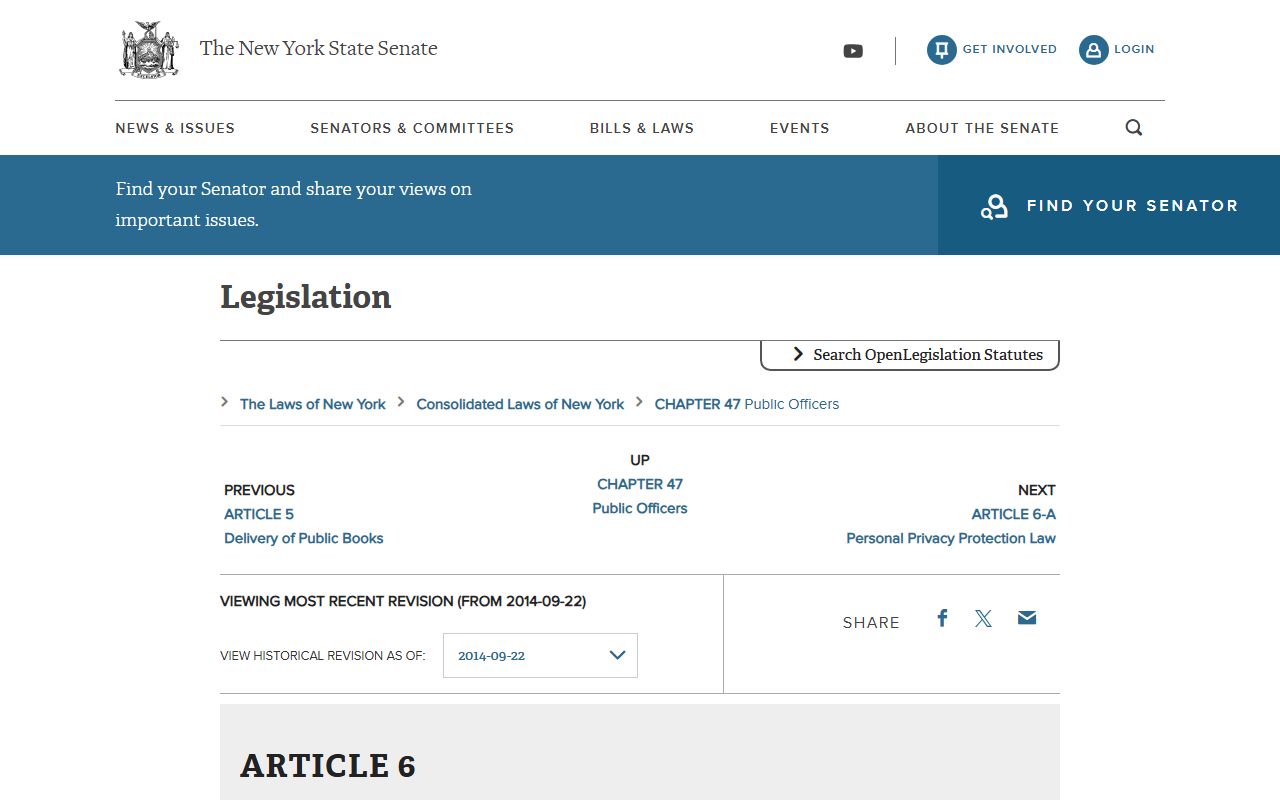
Public Officers Law Article 6 is the full text of FOIL as enacted and amended by the New York Legislature; reading it shows the specific language agencies must apply when responding to Onondaga County public records requests.
The key obligations for agencies appear in Public Officers Law § 87. That section lists what agencies must do, what they may withhold, and how they must handle requests. Common exemptions include records that would constitute an unwarranted invasion of privacy, records that would interfere with a law-enforcement investigation, information that would endanger public safety, trade secrets, and attorney-client privileged material. The exemptions are narrow and must be applied document by document, not used as a blanket reason to deny an entire response.
FOIL vs Court Records: The Onondaga County Distinction
The most common mistake in an Onondaga County public records request is routing a court-file inquiry through FOIL. The two systems are distinct, and the distinction matters in practice. A sheriff incident report is a record an agency created. It may be available through FOIL, subject to law-enforcement exemptions. A court docket from the same arrest is a court record. The Onondaga County Clerk maintains court records for Supreme and County Court cases; the clerk of each lower court keeps its own files. Sending a FOIL request to the county for a County Court criminal file will not produce the file, because the court is not a FOIL agency.
| Factor | FOIL Agency Record | Court Record |
|---|---|---|
| Governing law | Public Officers Law Article 6 (§§ 84-90) | Judiciary Law § 255; court rules; case-specific statutes |
| Examples | Sheriff incident report, county department memo, board meeting minutes | Supreme Court civil file, County Court indictment, Surrogate's Court probate petition, Family Court order |
| Where to request | Agency FOIL officer or county FOIL portal | Clerk of the court that holds the file |
| Response timeline | Statutory acknowledgment and response periods under PBO § 89 | Court clerk processing time; no FOIL clock applies |
| Appeal route | Internal agency appeal, then Article 78 proceeding in Supreme Court | Motion to the court holding the file; FOIL appeal process does not apply |
| Fee basis | PBO § 87 and § 89, agency fee rules | Judiciary Law; Onondaga County Clerk fee schedule |
The table above is a starting-point guide, not a guarantee of access. Every specific request still has to be evaluated against the full text of the applicable statute and any case-specific sealing or confidentiality order. A visible docket does not mean every underlying document is public, and a court can restrict access to any filing under its rules.
Court Records and Judiciary Law 255 in Onondaga County
Court clerks in New York have a statutory duty to search court records and furnish certified copies for authorized fees. That duty comes from Judiciary Law § 255. The statute is the reason a certified court record comes from the clerk of the issuing court rather than any county FOIL officer or executive department. For Onondaga County, that means the Onondaga County Clerk handles certified copy requests for Supreme and County Court files. Surrogate's Court records run through the Surrogate's Court clerk at 401 Montgomery Street. Family Court records run through the Family Court clerk at the same address.
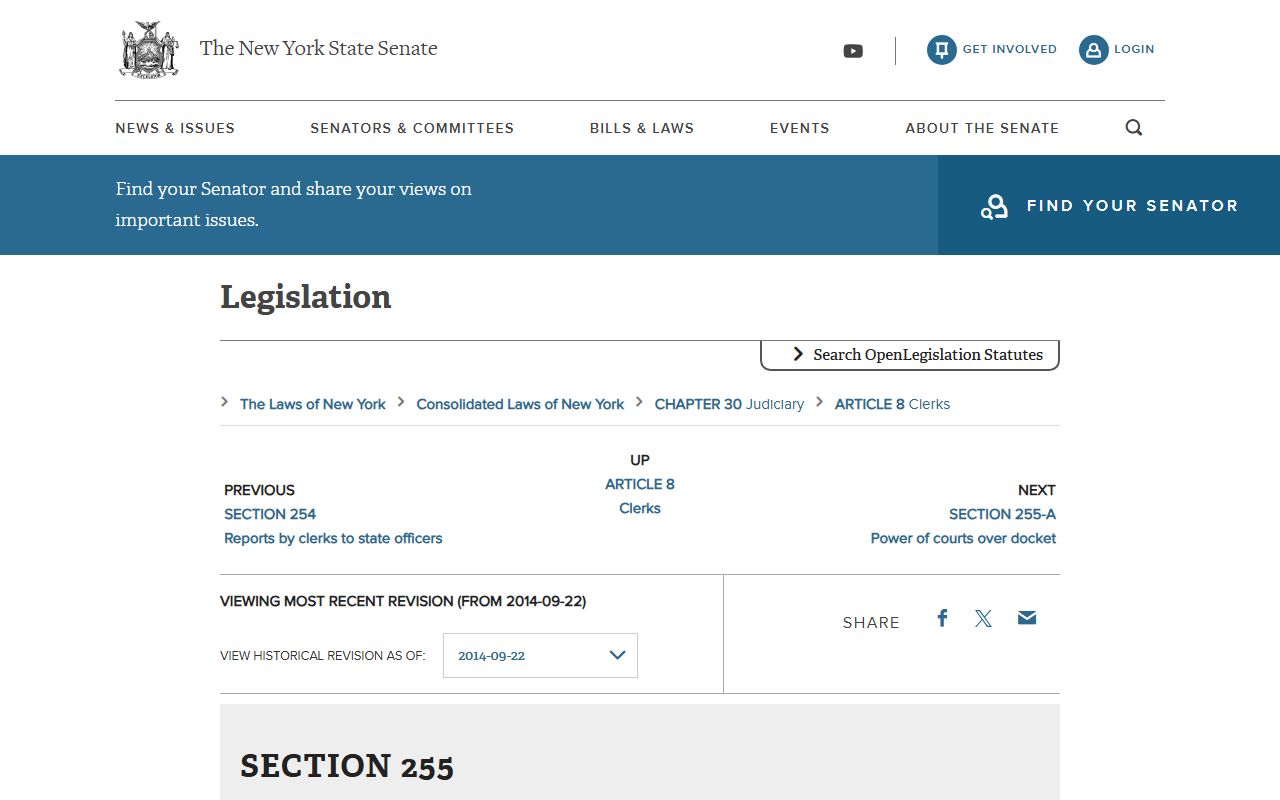
Judiciary Law § 255 is the source of the clerk's authority to certify copies of Onondaga County court records; a certified copy produced under this statute carries legal weight that an uncertified printout from an online search portal does not.
The online search portals, WebCivil Local, WebCrims, and WebSurrogate, let a user identify a file and view public docket information. They are useful for locating a case and checking status. But they are not substitutes for a certified copy. Employment background checks, immigration proceedings, licensing applications, and legal proceedings almost always require a certified disposition from the actual clerk. Anyone who needs a certified record should contact the Onondaga County Clerk at (315) 435-2229 or the specific court clerk directly.
What the Onondaga County Clerk Maintains
The Onondaga County Clerk, currently Emily Essi Bersani, maintains a large body of county records beyond court files. The office is at 401 Montgomery Street, Room 200, Syracuse, NY 13202, phone (315) 435-2229, open Monday through Friday 8:30 a.m. to 4:00 p.m. Many of these records are searchable through the Clerk's online portal, a Cott Systems platform at cotthosting.com/NYOnondagaExternal. The Cott portal is primarily a recorded land and document system, separate from the statewide WebCivil, WebCrims, and NYSCEF court portals.
The range of records the Clerk holds is wider than most people expect. Real property documents alone span decades of Onondaga County transactions. Business filings provide a searchable record of who operates under a trade name in the county. Judgment records give creditors and title searchers a way to check for outstanding liens.
- Deeds, mortgages, easements, and property maps recorded in Onondaga County.
- Judgments and liens filed against persons or property in the county.
- Business certificates and DBA (doing business as) filings; division phone (315) 435-2235.
- Uniform Commercial Code (UCC) filings; judgments division (315) 435-8200.
- Notary filings, passport acceptance, and naturalization records.
- Supreme Court and County Court civil and criminal action filings, as clerk of court.
A search for a deed or recorded lien starts at the Cott portal, not at a FOIL office. The portal lets users search by name, document type, date range, book and page, or instrument number. Login may be required to view document images. The County Clerk page explains the portal in full detail and covers the fee schedule for copies and recordings.
How to File an Onondaga County FOIL Request
Onondaga County uses the online FOIL portal at forms.ongov.net/foil-requests/ for records requests directed to county agencies. Each county department has its own FOIL officer, and the portal routes requests to the right office. A specific, well-described request gets a faster and more complete response than a vague one. The agency cannot locate and produce what it cannot identify from the description provided.
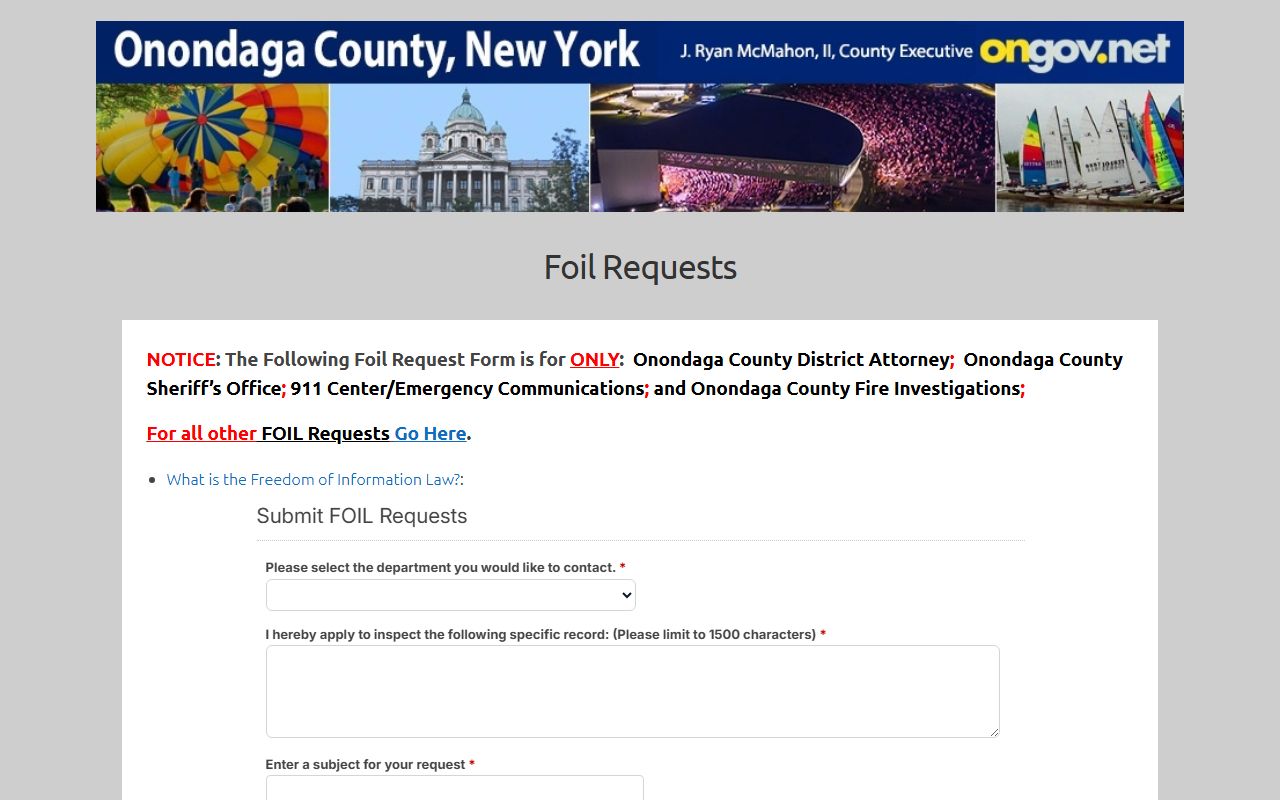
The Onondaga County FOIL portal at forms.ongov.net is the official gateway for submitting public records requests to county departments; use it rather than guessing a department's mailing address, since each agency routes requests through its own FOIL contact.
- Identify the county agency that created or likely holds the records. Common agencies include the Sheriff's Office for incident and accident reports, county health or environmental departments for regulatory records, the Legislature for meeting minutes and resolutions, or other county boards and offices.
- Describe the records with as much specificity as possible. Include dates, names, incident or case numbers, document types, or subject matter. A narrow, precise description is easier to fulfill than a request for all records on a subject.
- Open the FOIL portal at forms.ongov.net/foil-requests/ and complete the online form. Provide your name, contact information, the department you believe holds the records, and your description of what you need.
- Choose whether you want to inspect records in person, receive electronic copies, or receive paper copies. Electronic delivery is often faster and may carry lower fees than paper.
- Submit the form and keep a copy of what you submitted, along with any confirmation or reference number the portal returns. You will need this if a follow-up is required.
- Watch for an acknowledgment from the FOIL officer. Under Public Officers Law § 89, agencies must acknowledge receipt within a set number of business days and then either grant access, deny it with a stated reason, or provide a reasonable date by which a response will come.
- If the agency denies the request or fails to respond within the statutory period, preserve the denial or the record of non-response. A timely internal appeal comes first. If the internal appeal also fails, an Article 78 proceeding in Onondaga County Supreme Court can ask a judge to review whether the denial was lawful.
The full request rules, including fee limits, timing, and the appeal process, are set out in Public Officers Law § 89. Reading that section before filing helps set realistic expectations about how long the process takes and what options are available when a denial comes back.
FOIL Request Form Fields for Onondaga County
Whether a request goes to a county agency through the FOIL portal or to a court clerk directly, the same identifying information speeds processing. The table below shows the standard fields for an Onondaga County public records request and what each one is used for.
| Field | Required | Notes |
|---|---|---|
| Requester name | Yes | Needed to send the response back to you. |
| Mailing address or email | Yes | The channel where records or denial will be sent. |
| Phone number | Typically | Used by the FOIL officer to clarify an incomplete or unclear request before issuing a denial. |
| Record description | Yes | Names, dates, document types, case or incident numbers, subject matter. Specific beats general. |
| Department or agency | Helpful | Identify the custodian. Wrong agency wastes time. |
| Date range | Helpful | Narrows the search, reduces cost, and speeds response. |
| Preferred format | Yes | In-person inspection, electronic copy, or paper copy. State your preference. |
| Payment | If a fee applies | Follow the agency or clerk fee rule. Do not mail cash unless the agency explicitly allows it. |
A request framed as "all records about a person" is almost always rejected because the agency cannot identify a manageable set of files from that description. Narrow the request to a record type, a date range, and the department most likely to hold it.
Onondaga County Public Records Fees
Fees depend on which channel handles the request. FOIL copy fees are set by statute and agency rule. Court certified-copy fees follow Judiciary Law and the Onondaga County Clerk fee schedule at onondaga.gov/clerk/fees/. Recorded document fees are set by the Clerk and may vary by document type and length. The table below lists the verified County Clerk fees, which apply to clerk-issued copies and court-record requests handled by the Clerk's office.
| Service | Fee |
|---|---|
| Regular document copy | $0.65 per page |
| Personal copy | $0.25 per page |
| Certified copy | $5.00 minimum for first 4 pages, then $1.25 per page |
| Exemplified copy | $10.00 additional charge |
| Court records search | $5.00 per name, per 2-year period |
| Federal tax lien search | $40.00 |
| Business certificate / DBA filing | $35.00 |
| Apostille | $3.00 |
FOIL copy fees follow agency rules under Public Officers Law § 87. An agency can charge for the cost of producing a paper copy but generally not for the staff time spent locating records. Electronic records may be provided at no charge or at lower cost than paper. Check with the specific agency's FOIL contact for current copy rates before sending payment.
Note: Court filing fees, such as the $210.00 index number fee for Supreme Court actions, are separate from copy fees and are charged when a case is filed, not when a record is later requested by a third party.
Response Timelines and Denials
FOIL sets a rhythm rather than a single hard cutoff. An agency must acknowledge a request within a defined period. After acknowledgment, it must either grant access, deny the request with a reason, or give the requester a reasonable date by which a full response will come. A complex request involving many documents or careful redaction takes longer than a request for a single routine report. An agency cannot ignore a request, but the meaning of "reasonable time" can stretch for large or complicated records productions.
Court-record requests at the Onondaga County Clerk run on the clerk's own processing schedule. An older file may be stored offsite or exist only in paper form, which adds retrieval time. A certified copy requires both a search step and a certification step, and that takes longer than a plain copy. Anyone who needs a record for a specific deadline, such as a mortgage closing or a court filing, should submit the request early and follow up in writing.
A FOIL denial is not the end of the process. A requester can file an internal appeal at the agency within the time limits in Public Officers Law § 89. If the appeal is denied or the agency does not respond, an Article 78 proceeding in Onondaga County Supreme Court asks a judge to review whether the denial was lawful. For court-record access denials, the remedy is a motion in the court that holds the file, because the FOIL appeal process does not apply to judicial records.
Can I use FOIL to get a court case file in Onondaga County?
No. FOIL covers government agency records. Court case files, whether from Supreme Court, County Court, Surrogate's Court, or Family Court, are not agency records. They are requested from the clerk of the court that handled the matter, not through a FOIL officer. Routing a court-file request through FOIL is the most common reason an Onondaga County public records request does not produce the document the requester actually wants.
Restricted Records in Onondaga County
Not every Onondaga County record is open. Restrictions come from multiple statutes and apply regardless of whether the request is a FOIL request or a court-clerk request. On the FOIL side, law-enforcement exemptions under Public Officers Law § 87 allow an agency to withhold records that would interfere with an active investigation, identify a confidential source, or endanger a person's safety. Personal privacy exemptions protect medical information, financial account details, and home addresses in defined circumstances.
On the court-records side, restrictions are more categorical. Family Court records are restricted under Family Court Act rules and are not open to general public inspection. Youthful offender records are confidential under CPL § 720.35. Criminal records sealed under CPL § 160.50 after a favorable termination are not publicly accessible. Eligible older convictions sealed by application under CPL § 160.59 are similarly restricted. Divorce and matrimonial files are limited under Domestic Relations Law § 235. Adoption records, grand jury materials, orders of protection with confidential addresses, and mental health clinical records are also protected categories.
Right request, right office. Agency records go through FOIL at forms.ongov.net/foil-requests/. Court files go through the clerk of the court that handled the case. Recorded documents go through the Onondaga County Clerk at onondaga.gov/clerk/. Matching the request to the right custodian is the fastest way to get a usable record back.